
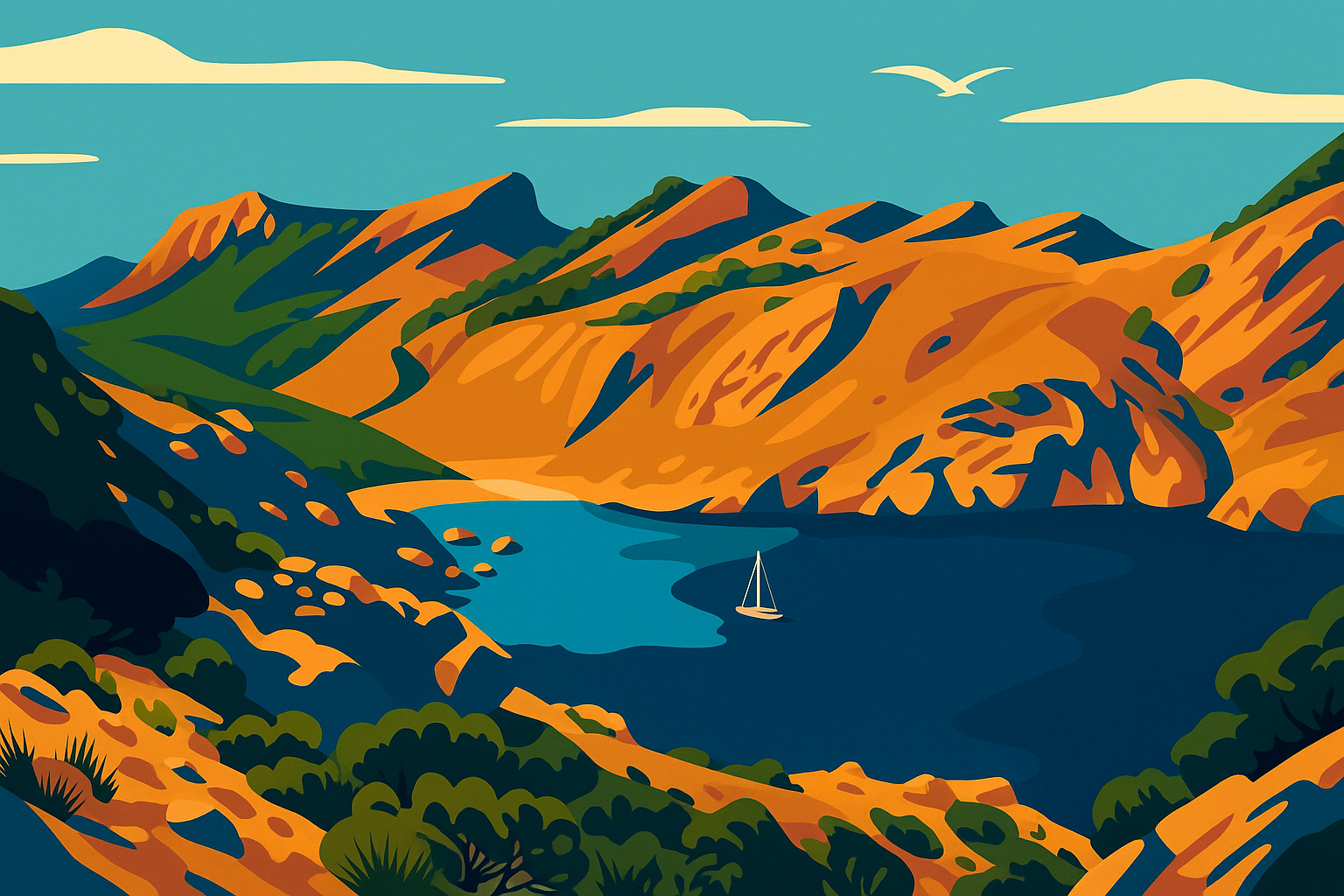
Cultural Landscape of the Serra de Tramuntana
Discover the most beautiful coves
To explore the hidden coves and move freely around the island, a car is your best solution. We recommend booking one in advance to secure the best price and not miss a single corner of paradise.
🔍 Find the perfect car for youThe Dragon’s Back: A Guide to Mallorca’s Serra de Tramuntana
This is not a passive landscape. The Serra de Tramuntana, a 90-kilometre mountain range forming the rugged backbone of northwest Mallorca, is far more than a postcard collection of “dizzying cliffs that fall into the sea” and idyllic villages. It is a living, breathing testament to a millennium of human ingenuity and resilience. In 2011, UNESCO did not designate it a World Heritage Site as a pristine nature reserve, but as a “Cultural Landscape.”
This distinction is the key to understanding its soul. The Tramuntana, dominated by its highest peak, Puig Major, at 1,443 meters, is the result of a “near-perfect symbiosis between the action of human beings and nature.” It is a monumental work, a story etched into its very slopes by generations who transformed a steep, arid, and resource-scarce environment into a productive oasis. This story is written in the ancient Arabic water channels that still feed its orchards, in the millions of dry-stacked stones forming its agricultural terraces, and in the cobbled streets of the hill towns that grew from this cultivated land. This is not a destination to be merely seen; it is a landscape to be read.
The Soul of the Tramuntana: An Atmosphere of Duality
The Tramuntana possesses a unique and powerful duality. It is simultaneously a place of raw, sublime power and of intimate, pastoral serenity. The atmosphere is defined by this tension—between the “abrupt silhouettes” of limestone peaks piercing the sky and the profound “calm and respect for nature” found within its sheltered valleys.
For centuries, this environment has served as a refuge for those seeking inspiration or escape. The “special light” of the region, filtered through pine forests and reflecting off the deep blue sea, has attracted generations of artists, musicians, and writers. The most famous of these were the composer Frédéric Chopin and the writer George Sand, who spent a famously productive and dramatic winter in the Valldemossa Charterhouse. Later, the British poet and novelist Robert Graves found his lifelong muse in the village of Deià, which remains a bohemian “artists’ retreat” to this day.
The air here feels different—scented with the sharp sweetness of citrus and olive groves, the clean tang of sea salt, and the resinous perfume of wild herbs. It is an atmosphere that demands a slower pace, compelling you to stop, breathe, and observe the intricate, beautiful relationship between the cultivated and the wild.
A Landscape Written in Water and Stone
The “Outstanding Universal Value” that UNESCO recognized is not a single feature but a complex, layered system developed over a thousand years. To visit the Tramuntana is to walk through a living historical document, with each layer revealing the influence of a different culture and technology.
The Arabic Legacy of Water
The landscape’s very foundation is built on water. During the centuries of Muslim rule, sophisticated irrigation systems were introduced to “harvest and transport water” in a climate defined by “long periods of drought.” These brilliant engineers built *qanats*—underground channels to tap the water table—as well as a vast network of canals, ditches, and storage basins. This “articulated waterworks network,” an exceptional example of Arab engineering, is what made agriculture, and therefore life, possible on these challenging slopes.
The Monument of Dry Stone
The second layer, and the most visually defining feature of the Tramuntana, is the monumental *pedra en sec* (dry-stone) construction. To cultivate the steep slopes, generations of Mallorcans built, by hand and “without mortar,” a vast system of terraces, or *márges*. These dry-stone walls, which also incorporate ingenious drainage mechanisms to prevent soil erosion, represent the “monumental work” that transformed the mountains into a productive landscape of olive groves, orchards, and gardens. They climb the mountains like giant staircases, a testament to incredible labour and agricultural wisdom.
From Feudal Estates to Hilltop Villages
Finally, the human settlement patterns grew directly from this engineered landscape. After the 13th-century Christian conquest, a “feudal system of land subdivision” was imposed, creating the large rural estates, or *posesiones*, and small farm holdings that still exist today. The villages, estates, and the “ancient cobbled paths” that link them are the final expression of this 1,000-year synthesis of Arab technology, Mallorcan labour, and feudal organisation.
Exploring the Tramuntana’s Treasures
The cultural and physical identity of the Tramuntana is best experienced through its three primary forms: its timeless villages, its breathtaking roads, and its ancient footpaths.
The Villages: Hubs of Culture and Stone
The villages of the Tramuntana are not just picturesque stops; they are the historic hearts that grew from the agricultural landscape around them.
- Valldemossa: Often considered the region’s cultural heart, Valldemossa is defined by its charming “cobbled streets” and the imposing Reial Cartoixa (Royal Charterhouse). This former palace and monastery is where Chopin and Sand spent their infamous winter of 1838-39. You can tour “Chopin’s cell” and see the Pleyel piano on which he composed his Preludes.
- Deià: This iconic “artists’ retreat” clings dramatically to a hill overlooking the sea. Its “bohemian atmosphere” now blends with a quiet, wealthy exclusivity. The village’s identity is inseparable from Robert Graves; his home, Ca n’Alluny, is now a meticulously preserved museum offering a fascinating insight into the poet’s life and work from 1929 until his death.
- Sóller: Nestled in a fertile “golden valley” of orange and lemon groves, Sóller has a distinct and prosperous character. Enriched by the citrus trade with France, its architecture features grand “modernist buildings” and French-influenced mansions. The lively Plaça de la Constitució is the centre of life, where the spectacular Church of Saint Bartholomew provides a backdrop to the clattering, wooden Sóller Tram as it makes its journey to the port.
- Fornalutx: An architectural “jewel,” Fornalutx has twice been named the “most beautiful village in Spain.” It is a “virtually unspoilt” and “traditional rustic” collection of stone houses, “narrow winding streets,” and “beautiful stone steps,” all set against the imposing backdrop of Puig Major. It is perhaps the purest expression of the region’s stone-built heritage.
The Road as a Destination: The MA-2141 to Sa Calobra
While the Ma-10 is the main artery, the MA-2141 road to Sa Calobra is an architectural destination in its own right. Designed by engineer Antonio Parietti and completed in 1932, this 13-kilometre “masterpiece of twists and turns” descends nearly 800 metres to the sea. It was famously built “manually, without the help of any machine,” and ingeniously designed to avoid any tunnels. Its most iconic feature is the “Nus de Sa Corbata” (Tie Knot), a unique 270-degree spiral bridge where the road loops under itself—a true marvel of engineering. The road terminates at the dramatic mouth of the Torrent de Pareis, one of Europe’s largest canyons.
The Ancient Footpath: Hiking the GR 221 Dry Stone Route
The GR 221, or “Dry Stone Route,” is the ancient nervous system of the Tramuntana. This long-distance hiking trail, stretching between 140 and 170 kilometres, traverses the entire range from Port d’Andratx to Pollença. It is an architectural feature in itself, following the “ancient cobbled paths” that once “linked mountain communities.” Hiking the GR 221 is a total immersion in the cultural landscape, taking you past old *cases de neu* (snow pits), *sitges* (charcoal kilns), and lime kilns—the silent remnants of the industries that once sustained these mountains.
Planning Your Tramuntana Journey: A Practical Guide
The Serra de Tramuntana is a public region, not an enclosed park, so it is accessible 24/7 with no general admission fee. However, a successful visit requires planning, especially regarding transport and timing.
How to Get There
All primary transport options originate from Palma’s central transport hub, the Estació Intermodal. The method you choose will fundamentally define your experience.
- By Car (The Flexible Explorer): Renting a car is “essential” for the freedom to stop at remote *miradors* (viewpoints) and explore at your own pace. The main artery is the Ma-10 road, a stunning scenic route of over 100km. Be warned: this road is “fairly winding” with “sharp bends,” and can be plagued by “heavy traffic in summer.”
- By Bus (The Practical Voyager): The TIB bus network is excellent and reliable. The key route is the L210/L211, which connects Palma to Valldemossa, Deià, and Sóller. This makes a self-guided day trip to the core villages convenient without the stress of driving or parking. It is also the best option for hikers tackling linear sections of the GR 221.
- By Historic Train (The Romantic): The Tren de Sóller is a “crowded tourist train” that is an attraction in itself. Vintage wooden carriages take you on a scenic journey from Palma through citrus valleys directly into Sóller town. From there, you can connect to the equally charming Tranvía de Sóller (est. 1913) for the 15-minute rattle down to Port de Sóller.
When to Visit
The “best” time to visit depends entirely on your intended activity.
- Spring (March–May): Arguably the best season. Temperatures are “pleasantly mild” (18-23°C), the “landscape bursts into color” with wildflowers, and you can explore “without the summer crowds.” Ideal for hiking and scenic driving.
- Autumn (September–October): The second-best season. It is “lovely, quieter” with “fewer crowds,” and the sea is still warm enough for swimming.
- Summer (June–August): The most challenging time. The region becomes “very crowded” with “heavy traffic.” However, it is “reliably sunny and hot,” and it is the only time the Torrent de Pareis gorge is dry and safe enough to hike.
- Winter (December–February): A “quiet” and peaceful time, but it can be “wet.” Snow can cap the highest peaks and temporarily close mountain roads, offering a different kind of beauty.
Facilities and Practicalities
The Tramuntana is a working landscape, not a modern theme park. Visitors must plan for a degree of self-sufficiency. The primary information hub is the Finca Raixa Visitor Center near Bunyola, a beautifully restored villa with gardens, free entry, and WCs. However, be advised that “there is no cafe on site.” For hikers on the GR 221, a network of “official mountain refuges (*refugis*)” provides affordable lodging, but booking well in advance is essential. The single greatest logistical challenge is parking. In popular villages like Valldemossa and Deià, parking is “limited,” “sparse and quite full,” and can be “a pain.” Arrive early in the day or consider using the bus to avoid frustration.
Beyond the Famous Four: Deeper Discoveries
While Valldemossa, Deià, Sóller, and Fornalutx are unmissable, the Tramuntana holds other essential destinations.
- Santuari de Lluc: This is the “spiritual center on the island of Mallorca,” a 13th-century monastery and pilgrimage site nestled high in the mountains. It’s an essential stop on the GR 221 and features a beautiful Basilica, a museum, and a serene botanical garden.
- Cap de Formentor: This is the dramatic northernmost tip of the peninsula where the mountains plunge into the sea. The drive leads to the iconic Formentor Lighthouse, with “jaw-dropping” views from the Mirador de Es Colomer. Note that car access is restricted from June 1st to September 30th, requiring the use of a shuttle bus.
- Port de Sóller: The “pretty harbour town” and coastal counterpart to Sóller, set in a large, protected bay. Arriving on the historic tram from Sóller town is a classic Mallorcan experience.
- Gorg Blau and Cúber: These two large reservoirs, a designated “Natural Monument,” supply water to Palma and offer a different, high-altitude perspective of the mountains, with popular and relatively flat hiking trails.
Capturing the View: The Best Photo Spots
For photographers, the Tramuntana offers iconic vistas at every turn.
- Mirador de Sa Foradada: Between Valldemossa and Deià, this is “one of the most popular viewpoints… especially around the sunset hours,” featuring a distinctive rocky peninsula with a natural hole.
- Mirador de Es Colomer: The “most famous viewing point” on the way to Cap de Formentor, offering staggering views of the “arid rocky coast and cobalt sea.”
- Plaça de la Constitució, Sóller: Capture the quintessential town shot of the historic tram passing directly in front of the “spectacular” modernist Church of Saint Bartholomew.
- Nus de Sa Corbata (Sa Calobra): From the dedicated viewpoint, photograph the road’s impossible 270-degree “tie knot” bend as it loops under itself.
- Fornalutx: The village itself is the photo spot. Its “picturesque stairways” and “narrow winding streets” offer endless compositions of unspoilt stone architecture.
- Mirador de Ses Animes: Near Banyalbufar, this spot features the ancient “Torre del Verger” watchtower, a “perfect sunset photo spot” against the sea.
Final Thoughts and Insider Advice
The Serra de Tramuntana is a world-class destination that rewards preparation and patience. Its roads are “not for the faint-hearted,” and its popularity can be its greatest challenge. To truly experience its “Outstanding Universal Value,” you must plan strategically.
For drivers, the best advice is to drive the Ma-10 from south to north (e.g., Andratx towards Pollença). This places the driver on the inner, mountain-side of the road, away from the sheer cliff edge, while giving the passenger the best, unobstructed views.
For hikers, the GR 221 is an unforgettable journey, but do not rely on trail signage alone. A physical map and a GPS device are non-negotiable.
But the most important advice is to reject the checklist. The fatal error is to race from Valldemossa to Deià, hunting for a parking space, only to race on to Sóller. The Ma-10 is not simply the road *to* these places; the road *is* the destination. The true Cultural Landscape is not found in the gift shops, but in the quiet pull-offs between the towns. It’s in the gnarled, centuries-old olive trees, the abandoned charcoal kilns, and the endless, silent *márges* that climb the slopes. The real Tramuntana reveals itself not to the driver, but to the wanderer.