
Casal Solleric
Discover the most beautiful coves
To explore the hidden coves and move freely around the island, a car is your best solution. We recommend booking one in advance to secure the best price and not miss a single corner of paradise.
🔍 Find the perfect car for youCasal Solleric: The Soul of Palma, Where Grand History Meets Contemporary Art
To walk the Passeig del Born is to walk through the very heart of Palma. This wide, tree-lined boulevard, famously dubbed the “city’s drawing-room,” is a masterpiece of 19th-century urban design, a river of life that flows from the tangle of the old city toward the sea. And set in its most prominent position, guarded by stone lions, is a building that is more than just an address—it is an experience. This is Casal Solleric.
At first glance, it presents itself as a magnificent 18th-century aristocratic palace, one of the grandest and last of its kind ever built in the city. But to step through its colossal doorway is to step out of the sun-drenched bustle and into a still, cool world of its own. The sound of traffic and shoppers fades, replaced by the echo of footsteps on the vast, uneven cobblestone patio.
This is the central paradox and principal magic of Casal Solleric. It is not a dusty relic. Since its acquisition by the city in 1975 and its rebirth as a public institution in 1985, this palace has become one of Spain’s most dynamic contemporary art centres. Its true identity lies in the electrifying dialogue between its 18th-century grandeur and the challenging, 21st-century artistic inquiry that now unfolds within its noble rooms. It is a space where the past is not memorialised but actively engaged, questioned, and re-contextualised.
Most remarkably, this entire world-class cultural experience—access to both a priceless architectural monument and a leading-edge art gallery—is completely free to enter, making it arguably the most accessible, high-value, and essential cultural destination in Palma.
The Atmosphere: A Sanctuary of Grandeur and Silence
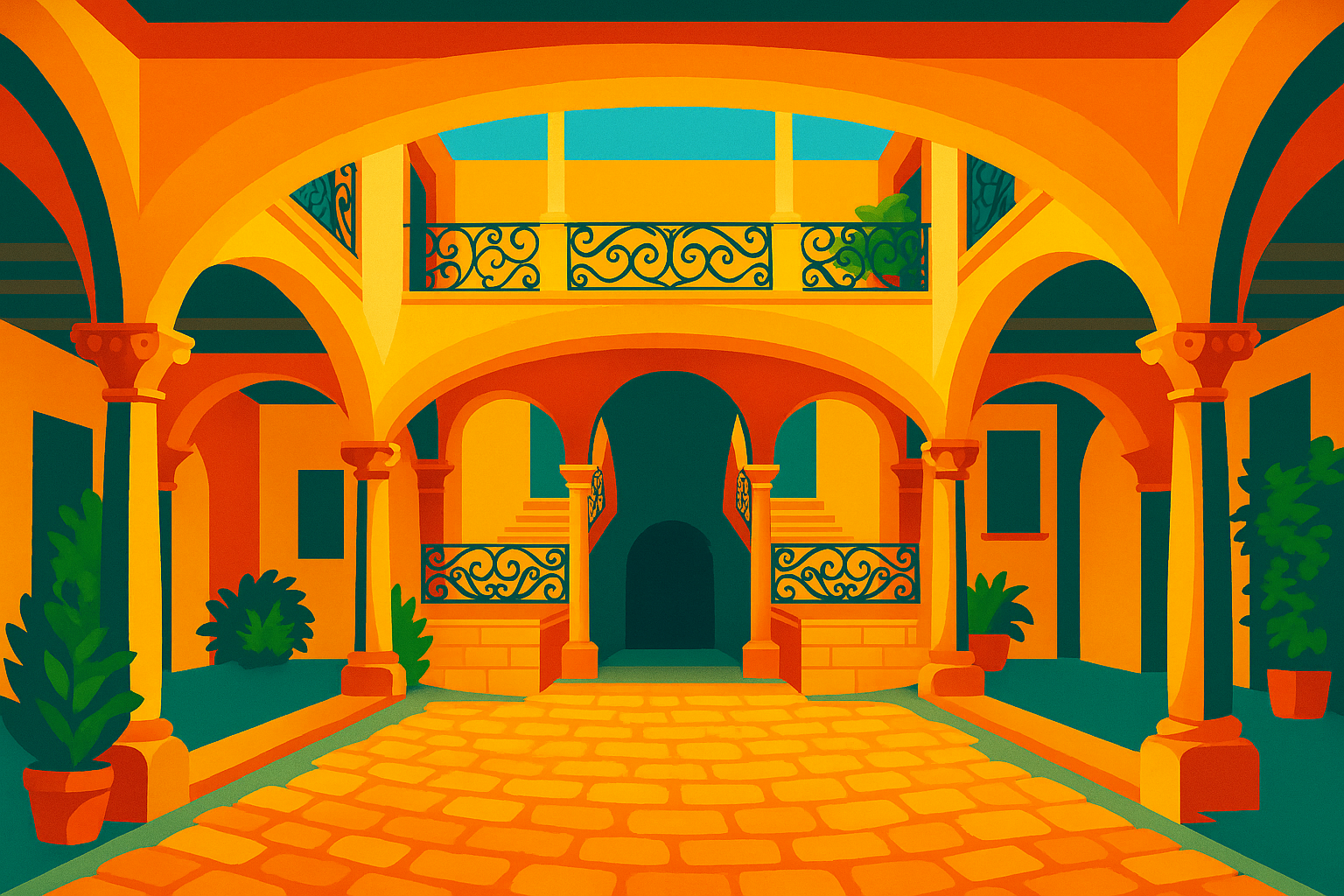
The atmosphere inside Casal Solleric is one of cool, echoing grandeur. The building is designed around its magnificent central patio, a feature typical of Palma’s grand houses but executed here on an unrivalled scale. Framed by graceful broad arches and paved with large, worn cobblestones, the patio functions as an open-air reception hall, a place of transition and orientation. It is a gem hidden in plain sight, a sanctuary from the high-end commercial luxury of the Born and the adjoining Avenida Jaime III.
Symbolically, the building’s very location is potent. It acts as the physical and historical hinge between the ancient, royal core of the city—the nearby Palau de l’Almudaina and La Seu Cathedral—and the 19th-century bourgeois expansion that defines modern Palma.
But its deepest symbolism is the transition from private power to public culture. The magnificent staircase, which sweeps up to the *planta noble* (noble floor), was once a stage for aristocratic theatre, a space designed to impress and intimidate. In its original incarnation, this upper floor was a hermetic sanctuary, a private world where no one other than close family was ever allowed to intrude. Today, those same doors are thrown open. The transformation of this exclusive aristocratic residence into a free, public-run art centre is a profound statement of cultural democratisation. It has turned a monument to private wealth into a vibrant platform for public dialogue and expression.
A Palace’s Tale: From Aristocratic Power to Public Art
The story of Casal Solleric is a story of Palma itself, capturing the zenith of one era and the birth of another. The palace was commissioned in 1763 and constructed over twelve years, completing in 1775. It was built for Miquel Vallès d’Almadrà i de Montaner, the Marquis de Solleric, a member of the immensely powerful Morell family.
This context is critical. The mid-18th century was the twilight of the Mallorcan aristocracy’s “golden age.” Casal Solleric is, therefore, one of the last great manor houses (*casals*) to be erected in the city. It was a monumental, final statement of power, wealth, and cultural sophistication by the Morell family, a dynasty solidifying its status in stone, marble, and iron. Its sheer scale and opulent, foreign-influenced design were intended to be a definitive landmark.
For two centuries, it remained in private hands, a symbol of this noble legacy. The Morell family were its last private residents, living in the palace until 1975. This date marks the building’s great pivot. With the aristocracy fading and the costs of maintaining such a structure becoming astronomical, the Palma City Council acquired the building, saving it from decline.
After a decade of careful restoration, it was launched as an exhibition centre in 1985. It is now managed by the Fundació Palma Espai d’Art, the city’s foundation for visual arts. This 20th-century rebirth gave the palace its modern purpose, ensuring its survival by transforming it from a private home into a public treasure. Its status as a protected monument was formalised when it was declared a *Bien de Interés Cultural* (Asset of Cultural Interest).
An Architectural Masterpiece in Transition
The architecture of Casal Solleric is its most debated and fascinating attribute. Travel guides and online sources are deeply conflicted, with many labelling it “Baroque” or “Rococo,” while others confidently describe it as “neo-classicist.” This confusion is not an error; it is the building’s defining feature.
Built in the 1760s and 1770s, Casal Solleric is a masterpiece of transition. It was constructed at the precise historical moment when the flamboyant, emotional, and highly decorative Baroque style was giving way to the rational, symmetrical, and grandly proportioned ideals of Neoclassicism. This brilliant dual identity is the direct result of its two principal creators, a Mallorcan architect and an Italian artist:
- Gaspar Palmer (The Architect): The local Mallorcan master, Palmer, was responsible for the layout. He designed the structure: the harmonious, symmetrical, and rational plan; the elegant combination of traditional Majorcan architectural elements; and the grand, airy design of the patio with its arched ceiling. His work is the building’s Neoclassical bone structure.
- Antonio Soldatti (The Artist): The Italian artist Soldatti was responsible for the decoration. He provided the palace’s soul. All the decorative sculptures and ironwork are his. This is the building’s late Baroque/Rococo flourish. His work is emotional, expressive, and extravagant.
This perfect synthesis is what makes the building so unique. Its two defining features are the ultimate expression of this partnership: the bright, spacious Patio, which the famed chronicler of the Balearics, Archduke Ludwig Salvador, famously called “one of the most beautiful in Palma,” and the theatrical Imperial Staircase. This magnificent flight of steps sweeps up to the *planta noble*, but it is the wonderfully complex, artistically forged wrought-iron banister that steals the show—Soldatti’s signature contribution, a burst of Italian flamboyance on Palmer’s orderly stage.
Planning Your Visit: Hours, Prices, and Practicalities
Free Entry: Palma’s Greatest Cultural Gift
The single most important piece of practical information about Casal Solleric is its admission policy: entry to the palace and all its world-class contemporary art exhibitions is completely free. This commitment to public access makes it an unparalleled cultural destination for any visitor to Palma, from the art connoisseur to the budget-conscious traveller.
A Word of Warning on Opening Hours
Visitors must exercise extreme caution regarding opening hours. Information online and in travel guides is notoriously inconsistent; different sources list at least four different sets of operating times. This confusion likely arises because the core hours can be modified depending on the installation requirements of the specific, rotating exhibitions on display.
Therefore, it is essential to verify the hours on the day of your visit. The only reliable source is the official one: check the casalsolleric.palma.cat website or the institution’s social media channels before setting out. As of the most recent updates, the hours are listed as Tuesday to Saturday from 10:00 to 20:00, and Sundays and holidays from 11:00 to 14:30 (closed on Mondays). Always double-check.
Ideal Visit Duration
For most visitors, a visit of 60 to 90 minutes is ideal. This provides ample time to absorb the architecture of the patio and grand staircase (15-20 minutes) and then explore the multiple, distinct exhibition spaces. Those with only a passing interest can appreciate the magnificent courtyard in under 30 minutes.
How to Reach Casal Solleric
Casal Solleric’s location is, simply put, prime. It is centrally and prominently located at Passeig del Born, 27, making it an unmissable landmark and an easy stop on any walking tour of Palma’s historic centre.
On Foot (The Best Approach)
Arriving on foot is the ideal way to experience the building in its urban context. It is a pleasant and easy 10 to 15-minute walk from Palma’s main historic monuments, including the Cathedral (La Seu) and the Almudaina Palace.
By Public Transport
The area is a major nexus for Palma’s municipal (EMT) bus network.
- Best Bus Stops: The closest stops are a mere one-minute walk away at Pl. de la Reina – Catedral (Stops 7, 453, and 986). The stop Pl. de Joan Carles I (Stop 53) is also just a few minutes away at the top of the Born.
- Key Bus Lines: These stops serve major tourist and local routes. Line 25 connects directly to s’Arenal and the Platja de Palma, while Line 35 runs from the Aquarium and Can Pastilla. The A1 Airport Bus has stops at the seafront and Plaça d’Espanya, both within a 10-15 minute walk.
By Car and Parking
Driving directly to Casal Solleric is strongly discouraged. The historic centre is a maze of narrow, restricted-access streets, and parking is exceptionally difficult. The best strategy is to use one of the large, 24/7 underground public car parks on the perimeter of the old town, such as the Parc de la Mar garage (beneath the Cathedral) or Parking Passeig Mallorca, and enjoy the short walk.
More Than a Gallery: Facilities and Services
One of the greatest strengths of Casal Solleric is that it functions as a full-service cultural and visitor hub. A main Palma municipal tourist information office is conveniently located right beside the main entrance, making it an outstandingly practical first stop.
The palace is also well-equipped for a complete cultural afternoon. It houses an elegant café with a highly sought-after and shaded terrace on the Passeig del Born, perfect for people-watching. Inside, a well-stocked art bookstore offers a curated selection of books, prints, and design objects. For more in-depth research, a public library specialising in contemporary art and photography is also on-site.
Regarding accessibility, visitors with mobility challenges should be aware that while the building is equipped with a lift and an entry ramp, its official rating for wheelchair circulation is “Partial.” This means access to the main ground-floor patio and parts of the upper floors is possible, but visitors should be prepared for potential limitations and uneven surfaces within the historic *planta noble* rooms.
The Best Time to Visit
The “best” time to visit Casal Solleric depends entirely on the desired experience.
- For Quiet Contemplation: The ideal time is a weekday morning, just after opening. The galleries are often nearly empty, allowing for a more personal experience with both the grand architecture and the contemporary art.
- For Atmosphere & People-Watching: Visit in the late afternoon, after 17:00. This allows a tour of the galleries as the day cools, after which you can emerge onto the Passeig del Born just as the city’s beloved *paseo* (evening stroll) begins.
- For Art Aficionados: The absolute best times are during major art events. The *vernissage* (opening night) of a new exhibition is a major social event. The two biggest moments are Palma’s city-wide Nit de l’Art (Art Night) in September and the exhibition for the Premi Ciutat de Palma (City of Palma Prize for Visual Arts) in January.
The Best Photo Spots
Casal Solleric is exceptionally photogenic. Here are four shots to capture its essence:
- The Classic (Architecture): Take a low-angle shot from the centre of the cobblestone patio, looking up at the imperial staircase. This composition captures the graceful arches and the full theatricality of the space.
- The Detail (Craftsmanship): Get a close-up of the artistically forged wrought-iron banister of the staircase. Its intricate, twisting forms tell a story of Italian Baroque craftsmanship.
- The Context (Street): Stand on the Passeig del Born to capture the building’s public face, framing the shot to include the unique gallery with five archways on the façade and the iconic stone lions.
- The “Pro” Shot (The Dialogue): The most meaningful photograph is one of juxtaposition. Go up to the *planta noble* and find a viewpoint where you can frame a hyper-modern piece of contemporary art within the ornate, 18th-century drawing rooms. This single image perfectly encapsulates the building’s entire modern story.
Beyond the Palace: What to See Nearby
Casal Solleric’s central location makes it the perfect anchor for several high-value walking itineraries.
The “Modern Art Triangle”
For a world-class survey of modern and contemporary art, link three of Palma’s best institutions. Start at Casal Solleric for cutting-edge installations, walk five minutes to the Museu Fundación Juan March for 20th-century Spanish masters (Picasso, Miró, Dalí), and finish at Es Baluard Museu d’Art Contemporani for major contemporary works and stunning views.
The “Historic Mile”
From the Born, you are steps away from Palma’s “Big Three” monuments: the Palau de l’Almudaina (the royal palace), the magnificent Gothic Cathedral (La Seu), and the 15th-century Gothic masterpiece Llotja de Palma (the historic maritime guildhall).
Luxury & Leisure
Casal Solleric is literally flanked by Palma’s two premier shopping streets. The Passeig del Born itself is a catwalk of luxury boutiques, while the adjoining Avenida Jaime III is the city’s main high-street shopping thoroughfare.
Final Thoughts and Insider Advice
Casal Solleric is not a dusty relic; it is a living, breathing institution. It is an 18th-century palace with a 21st-century mind, a place where history is not just preserved but is actively in conversation with the present. It defies easy categorisation, acting as a museum, a gallery, a meeting place, and a visitor hub all at once.
Don’t just visit Casal Solleric—use it. This is not a static ‘look-but-don’t-touch’ palace. Grab a coffee at the café, browse the art books in the shop, and then walk through the galleries. The true magic is experiencing the building as Palma’s residents do: as a public space for dialogue, where the past is not a relic, but the very stage on which the present unfolds.