
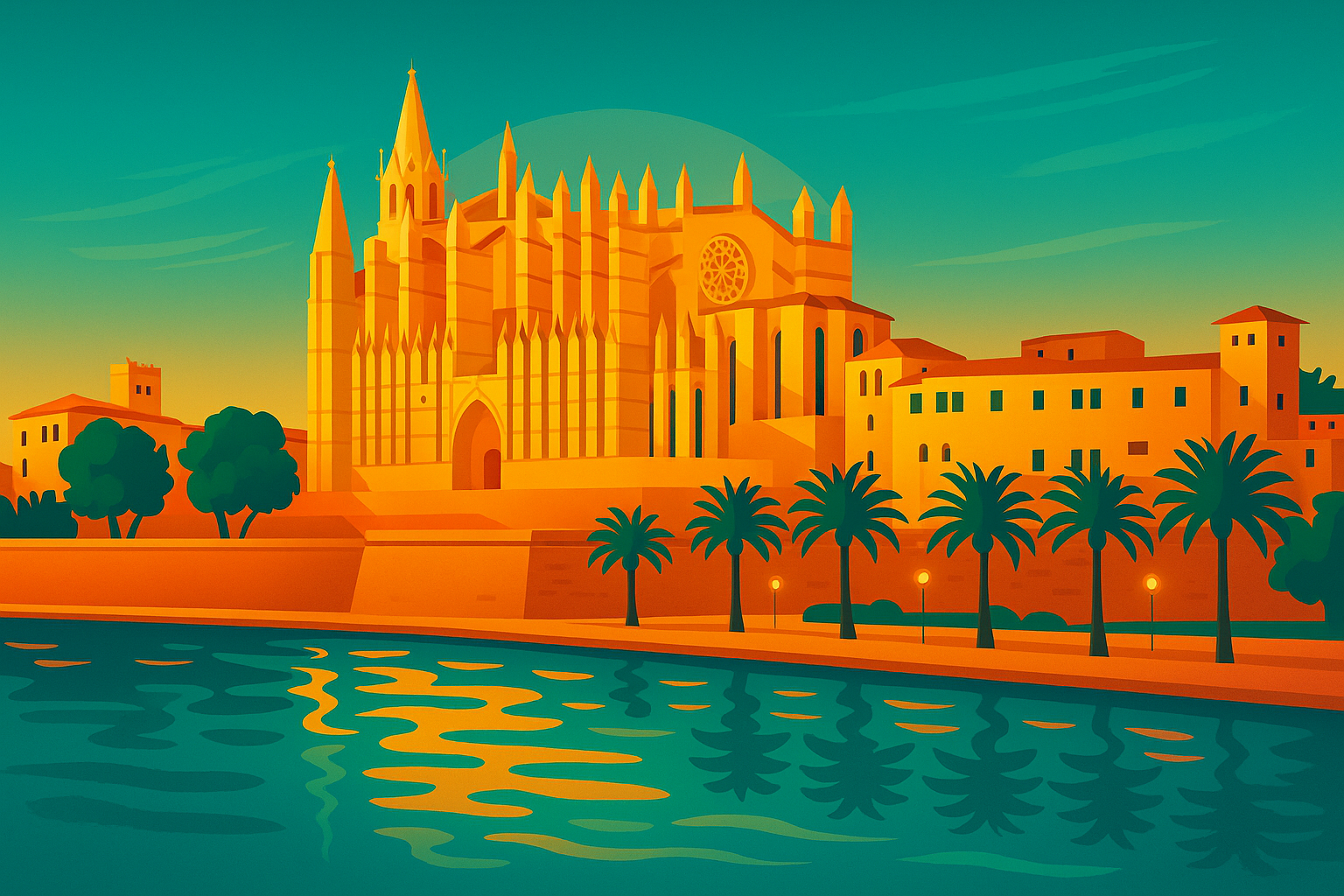
Palma de Mallorca Cathedral
Discover the most beautiful coves
To explore the hidden coves and move freely around the island, a car is your best solution. We recommend booking one in advance to secure the best price and not miss a single corner of paradise.
🔍 Find the perfect car for youThe Cathedral of Light: A Journey Through Palma’s Soul (La Seu)
It is an architectural impossibility, a fortress of faith that seems to float weightlessly above the Mediterranean. To approach Palma de Mallorca by sea, as conquerors and traders have for centuries, is to be confronted by La Seu, the Cathedral of Santa María of Palma. This is not a building that simply sits in the city; it is a building that is the city’s skyline. A colossal, 7,000-square-metre structure of golden Marès sandstone, it rises from the ancient Roman and Renaissance walls in a defiant cascade of spires and some of the most robust flying buttresses in the Gothic world.
But its true name, the “Cathedral of Light,” is not earned from its formidable exterior. It is an identity forged within. This is a structure engineered for the sun. With 87 windows and seven rose windows, its very purpose, etched in stone and mortar, is to capture the intense Balearic light and transform it into a divine, kaleidoscopic, and ever-moving spiritual experience.
To visit La Seu is to read a living document of history, an 800-year dialogue—and at times, a heated argument—between three distinct masters. This guide explores the cathedral not as a single monument, but as a journey through its three great layers: the audacious Gothic foundation, the organic intervention of Antoni Gaudí, and the profound, challenging confrontation of Miquel Barceló.
A Cathedral Forged by Light: The Festa de la Llum
To step inside La Seu is to have your sense of scale fundamentally rewritten. The atmosphere is one of profound, airy verticality. The sound of the city vanishes, replaced by a hushed echo and the scent of cool stone. The defining feature is not the decoration, but the sheer volume—a vast, unified space that pulls your eyes, and your spirit, upward.
The protagonist of this space is the main eastern rose window, known as the “Gothic Eye.” It is one of the largest Gothic rose windows in the world, a breathtaking masterpiece measuring nearly 12 metres in external diameter and composed of over 1,115 individual panes of stained glass. It doesn’t just let light in; it atomises it, creating what can only be described as a dreamlike atmosphere of shifting, coloured light.
This architecture of light finds its ultimate expression twice per year in a phenomenon known as the Festa de la Llum, or “Festival of Light.” On just two days—February 2nd and November 11th—a precise astronomical alignment occurs. Around 8:30 AM, the morning sun streams through the great “Gothic Eye,” travels the entire 121-metre length of the cathedral, and projects a perfect, luminous reflection of the rose window directly beneath its smaller counterpart on the western façade.
For a few fleeting minutes, the two windows form a perfect “figure 8” of light and colour, known locally as the ‘Vuit de la Seu’. This “miracle” is, in fact, a beautiful accident of history. The 14th-century Gothic architects who built the “Gothic Eye” could never have planned for this; the western façade was only rebuilt in its current form in the 19th century after an earthquake. This fortuitous alignment, a handshake across five centuries, carries deep symbolism: the palindrome dates (02/02, 11/11) and the figure 8, a universal sign of infinity, regeneration, and resurrection.
A Story Carved in Stone: 800 Years of History
The cathedral’s 800-year story begins not with prayer, but with a vow made during a storm. In 1229, King Jaume I of Aragon was sailing to conquer Mallorca from the Moors when a violent tempest threatened his fleet. He prayed to the Virgin Mary, vowing that if he was saved, he would build a magnificent temple in her honour.
He survived, landed, and took the city of Madina Mayurqa. His vow would be fulfilled with an act of profound political and religious superimposition. Construction began in 1230, and the location was chosen with deliberate, symbolic power: directly on the site of the city’s great Moorish mosque, which was demolished to make way for the new Christian monument.
This was not just a new church; it was a regime change carved in stone. The cathedral stands directly adjacent to the Royal Palace of La Almudaina. The Almudaina was the original Islamic fort, which Jaume I converted into his royal residence. Together, the new cathedral (religious power) and the converted palace (royal power) formed an undeniable, monolithic “power-block” on the city’s highest point. It was a monumental statement of Christian reconquest, aimed outward at the sea to greet all new arrivals with an image of absolute authority. Construction spanned 400 years, finally being completed around 1601, beginning, fittingly, with the Chapel of the Holy Trinity, commissioned by King Jaume II around 1300 to serve as the royal mausoleum for the new Mallorcan dynasty.
A Dialogue of Masters: The Three Souls of La Seu
La Seu is not one unified vision but a living dialogue between three brilliant, and disparate, artistic masters. To truly understand it, you must listen to each of their voices.
Master 1: The Audacious Gothic Foundation (14th–17th C.)
The original architects created an engineering marvel of the Levantine Gothic style. This style prioritizes a single, unified “hall-church” space over the divided naves of French Gothic. The goal was to create an overwhelming sense of light and space, and the result is breathtaking.
The central nave vaults soar to a height of 44 metres (144 feet), making it one of the tallest Gothic naves in the world. To achieve this staggering height and support the vast roof, the 14 pillars that line the nave are among the slimmest load-bearing pillars in the world relative to their height and the vault size. This audacious feat of engineering, which relies on the massive, double-arched flying buttresses visible from the outside, is what creates the cathedral’s signature feeling of weightless, light-filled immensity.
Master 2: Antoni Gaudí’s Organic Intervention (1904–1914)
By 1901, the cathedral was dark and cluttered, its Gothic purity obscured by centuries of additions. Bishop Pere Campins invited the radical Catalan architect Antoni Gaudí to restore its liturgical “dignity.”
Gaudí’s changes were both brilliant and controversial. His most significant act was to move the massive choir stalls from the centre of the nave (where they blocked the view of the altar) to their current position in the presbytery. This single act dramatically opened up the interior, restoring the sightline to the altar as the Gothic architects had originally intended.
His most visible contribution is the enormous, heptagonal baldachin (canopy) suspended over the high altar. This striking modernist piece, which appears to be a crown of iron and stained glass, was designed to channel light. But it holds a fascinating secret. The stunning canopy visitors photograph today is not the final piece. It is, in fact, a provisional, same-sized model made from “ephemeral material, such as card, paper, wire and wood.” Gaudí, famously, abandoned the project in 1914 after a bitter argument with the contractor. His “temporary” model was never replaced, and this 100-year-old “ghost” has become a permanent and beloved fixture.
Master 3: Miquel Barceló’s Modern Confrontation (2001–2007)
If Gaudí conversed with the Gothic, Mallorcan artist Miquel Barceló confronted it. In 2007, Barceló unveiled one of the most radical contemporary art installations ever placed within a historic European cathedral.
In the Chapel of the Santísimo (also known as St. Peter’s Chapel), Barceló created a 300-square-metre polychrome ceramic mural. The official theme is the New Testament miracle of the loaves and fishes. The experience, however, is far from a gentle Bible story.
Barceló, a self-proclaimed agnostic, transformed the Gothic chapel into a “mysterious cave.” The ceramic walls are cracked, earthy, and primal, erupting with swirling fish, fruit, and, most controversially, human skulls. To complete the chthonic atmosphere, Barceló replaced the chapel’s windows with five 12-metre-high grisaille (grey-toned) panes to create a sombre, “underwater” light. This is a dark, earthly, and challenging creation, a masterpiece of tension that contrasts the soaring, divine light of the main nave with the dark, primal earth of its origins.
Planning Your Visit: Tickets, Times, and Terraces
Planning a visit requires understanding the three distinct ways to enter, as they are often confused by third-party sellers, leading to frustration. Here is a clear breakdown of your options.
- The Standard Cultural Visit
- Price: 10€
- What it is: This is the default option for most visitors. It grants you access to the main Cathedral nave, all side chapels (including Barceló’s masterpiece), and the adjoining Museum of Sacred Art (MASM).
- Ideal Duration: Allow 60–90 minutes for a comfortable visit.
- The Premium Terrace Visit
- Price: 25€
- What it is: This is the highly recommended “insider” experience for the able-bodied. It includes everything from the Standard Visit plus access to the rooftops. This involves a 215-step climb to walk among the flying buttresses, see the bell tower (“Eloi”), and get an unparalleled close-up view of the “Gothic Eye” rose window and 360-degree panoramas of Palma.
- Availability: This is a seasonal experience, typically available only during the warm months from April to November. Tickets are limited and must be booked online in advance.
- Crucial Restrictions: Due to the narrow, historic 215-step climb, this visit is strictly prohibited for children under 9 years old, anyone with reduced mobility, or those with vertigo or cardiorespiratory conditions.
- The Liturgical Visit (Attending Mass)
- Price: Free
- What it is: This is for worship only, not for tourism. Photography is forbidden, and access is restricted to the designated worship areas. This is, however, the only way to enter on Sundays, when the cathedral is closed to tourist visits. Mass times are generally 09:00 (Mon-Sat) and 10:30, 12:00, and 19:00 on Sundays.
Essential Visitor Information
A little planning goes a long way to ensuring a smooth and respectful visit to this active house of worship.
How to Get There
The cathedral is the unmistakable heart of Palma’s Old Town (Casco Antiguo), located at Plaça de La Seu, s/n.
- By Public Transport (Recommended): Palma’s public transport is excellent. From the central hub at Estació Intermodal (Plaça d’Espanya), the easiest route is the EMT Bus Line 35. It runs frequently (every 15-20 minutes), is very affordable, and drops you at stop 986-pl. de la Reina – Catedral, just a one-minute walk from the entrance.
- By Car (Not Recommended): Driving and parking in the labyrinthine Old Town is extremely difficult. If you must drive, do not attempt to park on the street. The only viable option is the large, multi-level underground public car park named Parc de la Mar, located directly beneath the park and lake in front of the cathedral. Arrive early, especially in high season, as it fills quickly.
- From the Cruise Port: The cruise terminal is not within comfortable walking distance. A taxi is the fastest option (10-15 minutes). Alternatively, the EMT Bus Line 1 (Aèroport-Ciutat-Port) connects the port to the city centre; disembark near the cathedral.
- On Foot: If you are staying anywhere in the Old Town, the cathedral is the primary landmark and is best reached on foot, allowing you to soak in the atmosphere of the surrounding streets.
Rules, Facilities, and Insider Tips
- The Dress Code is Non-Negotiable: A strict dress code is enforced, and entry can be refused. Shoulders and knees must be covered by all visitors. This means no tank tops, strapless tops, shorts or skirts above mid-thigh, swimwear, or see-through clothing.
- Accessibility: The main floor of the Cathedral and the MASM are accessible to visitors with reduced mobility and wheelchair users. However, the Terraces are NOT accessible under any circumstances due to the historic staircases. The cathedral does not have wheelchairs available for visitor use.
- Bags and Luggage: For security reasons, large backpacks, travel suitcases, or other bulky packages are not allowed inside the cathedral.
Insider Tip: The cathedral itself has no lockers, but the adjacent MASM (Museum of Sacred Art), included in your 10€ ticket, offers a left-luggage service. You can securely leave your bags there before entering.
Audio guides are available for an extra fee. A gift shop and toilets are also located on-site. Pets are not allowed, with the exception of certified assistance dogs.
When to Visit: Finding Your Perfect Moment
There is no single “best time” to visit; the ideal time depends entirely on what you want to experience.
- For the “Cathedral of Light” Experience: Visit in the morning. This is when the eastern sun streams through the “Gothic Eye,” flooding the interior with a spectacular show of coloured beams that paint the stone pillars.
- For the Ultimate Experience (Festa de la Llum): You must plan your trip for February 2nd or November 11th. Arrive by 7:30 AM to secure a spot to witness the light phenomenon at 8:30 AM.
- For the Premium Experience (The Terraces): You must visit between April and November, as the terraces are closed in winter. This coincides with the peak tourist season, so book well in advance.
- For Fewer Crowds: The quietest months are during the low season: January to March and November.
- The “Golden Window”: The ideal compromise is early November. It is low season, the terraces are often still open for the first part of the month, and your visit can include the magical “Festa de la Llum.”
The Cathedral’s Historic Neighborhood
The cathedral is the anchor of a “must-see” historic cluster. After your visit, complete the story with this “trilogy” of sites, all within a few steps of each other.
- The Power: Royal Palace of La Almudaina: This is the essential complementary visit, located directly opposite the cathedral’s entrance. As the converted Islamic fort, it is the other half of the “power-block.” Visiting both tells the complete 800-year-old story of the Reconquista and the Mallorcan monarchy.
- The Reflection: Parc de la Mar: This is the large park with the artificial saltwater lake at the foot of the cathedral walls. Until the 1960s, the Mediterranean Sea lapped directly against the city walls, giving the cathedral a perfect reflection. When a new road severed that connection, the lake was purpose-built in the 1970s to recreate that lost image. It is the location for the best photos.
- The Contemplation: Jardí del Bisbe (The Bishop’s Garden): A true insider’s secret. Hidden just behind the cathedral is this tranquil, free-to-enter botanical garden. It offers a serene escape from the crowds, with a classical layout of fruit trees, herbs, and a pond, providing a quiet, privileged view of the cathedral’s roof and apse. Note its limited hours, typically 07:00–13:30 and closed on weekends.
Capturing La Seu: The Best Photo Spots
- The Classic (Parc de la Mar): The most iconic, postcard-perfect shot is from across the artificial lake in Parc de la Mar. Stand in the “Ses Voltes” area to frame the cathedral’s reflection with the lake and palm trees in the foreground.
- The Exclusive (The Terraces): The 25€ terrace ticket buys you photographs unavailable to anyone else: 360-degree panoramas of Palma and the bay, intimate close-ups of the Gothic flying buttresses, and a unique external view of the “Gothic Eye.”
- The Interior (The Light): The best interior shot is in the morning, capturing the kaleidoscopic beams of light from the rose window as they paint the opposite wall and pillars.
- The Golden Hour (The Façade): The “golden sandstone” of the cathedral positively glows at sunset. A shot from the Parc de la Mar or the city walls as the sun goes down is spectacular, as is a shot at night when the entire structure is illuminated.
A Final Word: Listen to the Dialogue
La Seu is not a static museum to be ticked off a list. It is a living, breathing, 800-year-old conversation, etched in stone and glass. It demands more than a quick photograph; it demands that you listen to the dialogue between its three masters.
Feel the soaring, divine awe of the 14th-century Gothic nave. Stand under Antoni Gaudí’s 100-year-old “ghost” baldachin and appreciate his radical quest for organic light and space. But your visit is incomplete until you find the final, modern chapter.
Do not make the mistake of leaving after seeing the main altar. The cathedral’s most challenging and modern soul is hidden in the Capilla del Santísimo. Seek out Miquel Barceló’s ceramic cave. You may not ‘like’ it, but its dark, earthy, and profound symbolism is the final, essential chapter in La Seu’s 800-year story.
To visit La Seu is to walk through light, time, and the very soul of Mallorca.