
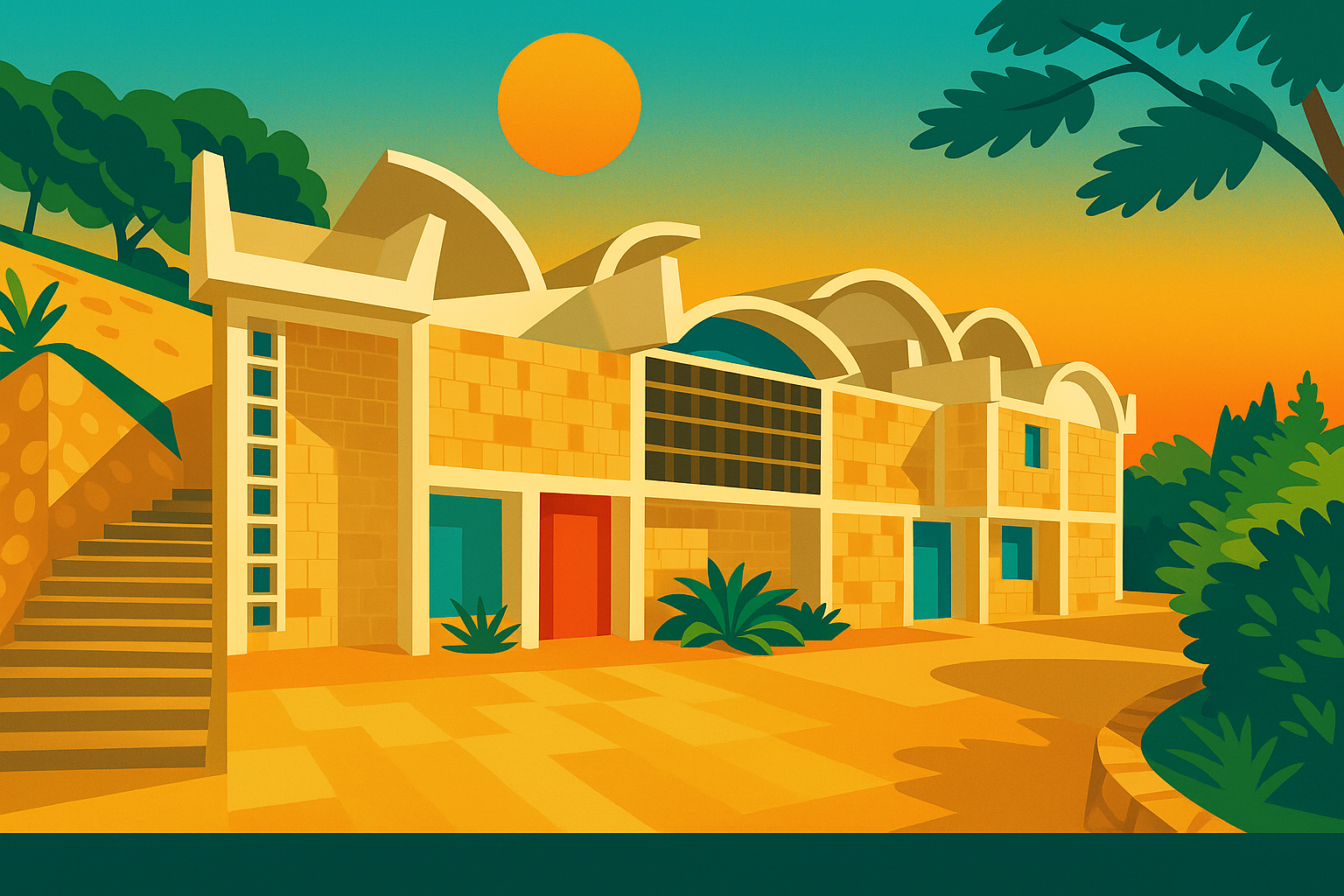
Pilar and Joan Miró Foundation in Mallorca
Discover the most beautiful coves
To explore the hidden coves and move freely around the island, a car is your best solution. We recommend booking one in advance to secure the best price and not miss a single corner of paradise.
🔍 Find the perfect car for youWhere Light Speaks: A Journey into Joan Miró’s Soul in Mallorca
To call the Fundació Pilar i Joan Miró a museum is to miss the point entirely. Stepping through its gates on a tranquil hillside in Cala Major isn’t about observing art in a sterile gallery; it’s about entering a biography. This is a preserved sanctuary, a creative vessel left so perfectly intact that the experience feels almost uncomfortably intimate, like being granted a private viewing into the mind of a modern master. This was Joan Miró’s home and workspace for nearly three decades, from 1956 until his death in 1983, and it remains a place that speaks not of finished products, but of the sacred, messy, and luminous process of creation itself.
Here, the air is thick with the ghosts of inspiration. Jars of brushes stand at attention, floors bear the splatters of masterpieces, and half-finished canvases wait for a touch that will never come. Humble collections of postcards, stones, and folk art that ignited his genius remain frozen in time. This is a place of profound silence, where art and nature are locked in a permanent embrace, all built upon the foundation of the one thing Miró cherished above all: the unique, clarifying “light of Mallorca.”
The Spirit of the Place: Art, Light, and Silence
Your experience of the Fundació begins not at a ticket counter, but in the garden. Perched on the Ca’n Saridakis hill overlooking the shimmering bay of Cala Major, the grounds are a curated world of deliberate contemplation. The sculpture gardens are the connective tissue of the complex, a space where Miró’s powerful bronze figures are not merely displayed but are active collaborators with the landscape. Framed by native pine trees, rugged cacti, and ancient olive groves, they force a constant, compelling dialogue between human artifice and the raw Mediterranean earth.
The true genius of this place, its soul, derives from its astonishingly preserved state. The atmosphere is a direct manifestation of Miró’s own wish: “I want everything that I leave behind to stay just as it is when I am gone.” The effect is uncanny. Time hasn’t just stopped; it feels suspended. You are not a tourist consuming art but a privileged guest, an almost voyeuristic witness invited into the artist’s most sacred space.
The primary, invisible material here is the light. It was this specific Mallorcan brilliance that Miró sought his entire life, a quality he felt was essential to his work. You can feel it as it pours through the precisely angled windows of his main studio, dapples the rough 18th-century walls of his second, and illuminates the cool, modern concrete of the main gallery. This light is the alpha and omega of the Fundació—the reason for its creation and the source of its enduring power.
A Tale of Two Foundations: Understanding Miró’s Mallorcan Legacy
It’s essential to clarify a common point of confusion, especially for those familiar with Barcelona’s cultural landscape. The Fundació Joan Miró in Barcelona, located on Montjuïc, is a magnificent public museum established by the artist in 1975. It is designed to showcase the comprehensive breadth of his finished work to the world.
The Fundació Pilar i Joan Miró in Mallorca is a different entity entirely. This was his private world. Gifted by Miró and his wife, Pilar Juncosa, in 1981, it was conceived not as a conventional museum, but as a future research center and an intimate window into his creative process. To put it simply: Barcelona shows you *what* Miró made; Mallorca shows you *how* and *why* he made it.
The artist’s move to the island in 1956 was no whim; it was a profound homecoming. His connection was triple-bound. Biographically, it was his ancestral home—his mother was from Palma and his wife, Pilar, was Mallorcan. Historically, it was his sanctuary. Fleeing the German invasion of France, Miró and his family took refuge here from 1940 to 1943. It was during this period of intense isolation, illuminated by the island’s light, that he created one of his most important series, the *Constellations*. The final move was the fulfillment of a lifelong dream: to build a permanent, stable, and light-filled studio where his creativity could finally find a permanent anchor.
An Architectural Dialogue Through Time
The unadulterated genius of the Fundació is its architectural storytelling. The site is not one building but three, an “architectural triad” from three distinct eras, each representing a different facet of Miró’s life and work.
The Taller Sert (1956): A Modernist Dream of Light
This studio was, in Miró’s own words, his “dream come true.” After a lifetime of working in cramped, inadequate quarters, he commissioned this perfect creative space from his close friend and fellow Catalan, the great architect Josep Lluís Sert. Now declared an Item of Cultural Heritage, the Taller Sert is a masterpiece of mid-century modernism.
Its iconic, vaulted “butterfly” roof and high clerestory windows are not mere stylistic flourishes; they are functional instruments meticulously designed to capture, diffuse, and manage the intense Mallorcan light. The design provides a consistent, shadowless environment perfect for painting. The large, two-level interior allowed Miró to work on multiple large-scale canvases simultaneously, a freedom he had never known before. It is a rational, clean, light-filled cathedral for creation.
Son Boter (18th Century): The Ancestral Anchor
Important Note: As of our latest information, the Son Boter studio is temporarily closed to the public for essential restoration work. We strongly advise checking the official Fundació website for the most current status before your visit.
Its significance, however, remains central to understanding Miró. In 1959, just three years after completing his perfect modern studio, Miró purchased this adjacent 18th-century Mallorcan farmhouse (*finca*) with prize money from the Guggenheim International Award. Why? If the Taller Sert represented the rational and the new, Son Boter provided the history, the earth, and the “ancestral anchor” he craved.
Described as a “cave” and a “return to the maternal womb,” Son Boter became his second studio for sculpture and printmaking. Here, in its rawest form, Miró’s art and the architecture became one. The building itself became his notebook. He drew directly onto the old, rough plaster walls in charcoal, leaving sketches, forms, and ideas that remain today—a breathtaking, raw display of pure creative impulse.
The Moneo Building (1992): A Fortress for Art
The final piece of the triad is the main public-facing building, designed by Pritzker Prize-winning architect Rafael Moneo and inaugurated in 1992. This structure houses the exhibition galleries, library, shop, and café. But its design is far more profound than a simple gallery. Moneo was tasked with adding a public component to a deeply private sanctuary, all while the surrounding Cala Major area was succumbing to the “dilapidated environment” of mass-market tourism.
His solution was brilliant. The Moneo building is a “bastion,” a modern fortress. Its stern, linear, concrete form and innovative water-covered roof are intentionally defensive. It acts as a large, protective wall that shields the two fragile, historic studios from the noise, visual clutter, and intrusion of the outside world. It is a masterful piece of architectural storytelling, preserving the silence and contemplative spirit of Miró’s sacred spaces.
Planning Your Visit: Practicalities and Insider Tips
Now that you understand the soul of the place, let’s cover the practicalities of your visit.
Getting There: Transport and Parking
The foundation is conveniently located in the Cala Major district, just west of central Palma, at Carrer de Saridakis, 29, 07015 Palma.
For those arriving by car, the foundation is exceptionally accommodating, providing a large, free private car park with 60 spaces for visitors. There are also 2 dedicated disabled parking spaces, a designated area for motorbikes, and 12 bicycle parking spaces at the entrance.
Public transport access is also excellent. Several bus lines stop nearby. Key routes from Palma’s local EMT service include lines 4, 46, and 20. The inter-island TIB bus service also has stops in the area. The crucial stop to look for is “Saridakis (Fundació Miró).”
Hours, Tickets, and Essential Know-How
The Fundació Pilar i Joan Miró is open from Tuesday to Saturday, 10:00 to 18:00. Sunday hours are shorter, from 10:00 to 15:00. It is critical to note that the entire complex is closed every Monday.
General admission is €10.00. Concessions are available for students and seniors (€5.50).
A crucial piece of practical advice: the foundation is an entirely cashless institution. You must bring a credit or debit card to pay for admission, as well as for any purchases in the shop or café.
While a quick walk-through is possible, it defeats the purpose of the visit. The foundation officially suggests a minimum visiting time of 2 hours. To truly absorb the atmosphere, explore the gardens, and enjoy the space, we recommend setting aside a full half-day (3-4 hours).
Facilities and Accessibility
The foundation is well-equipped with high-quality services. The Pilar Juncosa Library is a public-access research library specializing in contemporary art, holding over 20,000 documents. The shop, La Botiga, offers a highly curated selection of goods and, uniquely, sells original prints created by contemporary artists in the foundation’s on-site studios—an exceptional souvenir.
The Café, situated in the sculpture garden with a splendid terrace, offers “marvelous views” back toward the Moneo Building and is a perfect spot for reflection.
Regarding accessibility, there is a critical nuance. While the main Moneo building is accessible and there are disabled parking spaces, the historic nature of the site presents challenges. The gardens and historic studios have uneven surfaces, and tour operators explicitly warn that they are not recommended for wheelchairs, strollers, or those with significant mobility restrictions. Visitors with concerns should call ahead to confirm the extent of accessible areas.
The Perfect Timing: When to Experience Miró’s Sanctuary
To avoid the largest crowds, the best time to visit is on a weekday morning. However, data reveals a fascinating insight for the independent traveler. The busiest time is reported to be Tuesday around 12:00 PM, likely due to tour groups.
Counter-intuitively, the quietest day is listed as Saturday. This is highly unusual for a major European cultural site and suggests that a Saturday visit may offer a surprisingly serene and crowd-free experience. The only time to definitively avoid is Monday, when the entire complex is closed.
Beyond the Foundation: A Miró Trail Through Palma
A visit here can be the starting point for a wider “Miró Trail” across the city:
- Start at the Fundació to understand his process and soul.
- Travel to the Parc de la Mar, the large park below the cathedral, to see the massive, vibrant ceramic wall mural Miró donated to the city.
- Conclude at the Es Baluard Museu d’Art Contemporani de Palma. Built into the city’s 16th-century walls, this museum holds works by Miró in its permanent collection, placing him in dialogue with other masters like Picasso and Magritte.
Capturing the Moment: Best Photo Spots
The photographic potential here lies in its intimate details and architectural grandeur.
- The Artist’s Perspective: The most potent images are captured inside the Taller Sert. Focus on the details: the unfinished canvases, the jars of brushes, the wall of inspirational objects, and the paint-splattered floor. Capture the studio “frozen in time.”
- Art in Nature: The Sculpture Garden provides the best opportunity to frame Miró’s powerful bronzes against the deep blue of the Mallorcan sky and the green of the native pines.
- Architectural Dialogue: From the café terrace, capture the “marvelous views” back toward the Moneo Building, framing its modern form within the garden. Focus on the play of light on its unique water-covered roof.
Do not rush the Taller Sert. This is the heart of the entire experience. Stay for at least 15 minutes. You are standing in the very spot where his final masterpieces were born. It is a space for contemplation, not consumption.
A visit to the Fundació Pilar i Joan Miró is a rare and profound privilege. It is an active invitation into an artist’s mind, a space designed for quiet, deep reflection. As a final reminder, check the foundation’s official website for the current restoration status of the Son Boter studio, and remember to bring a bank card. Then, prepare to step out of time and into the light.