
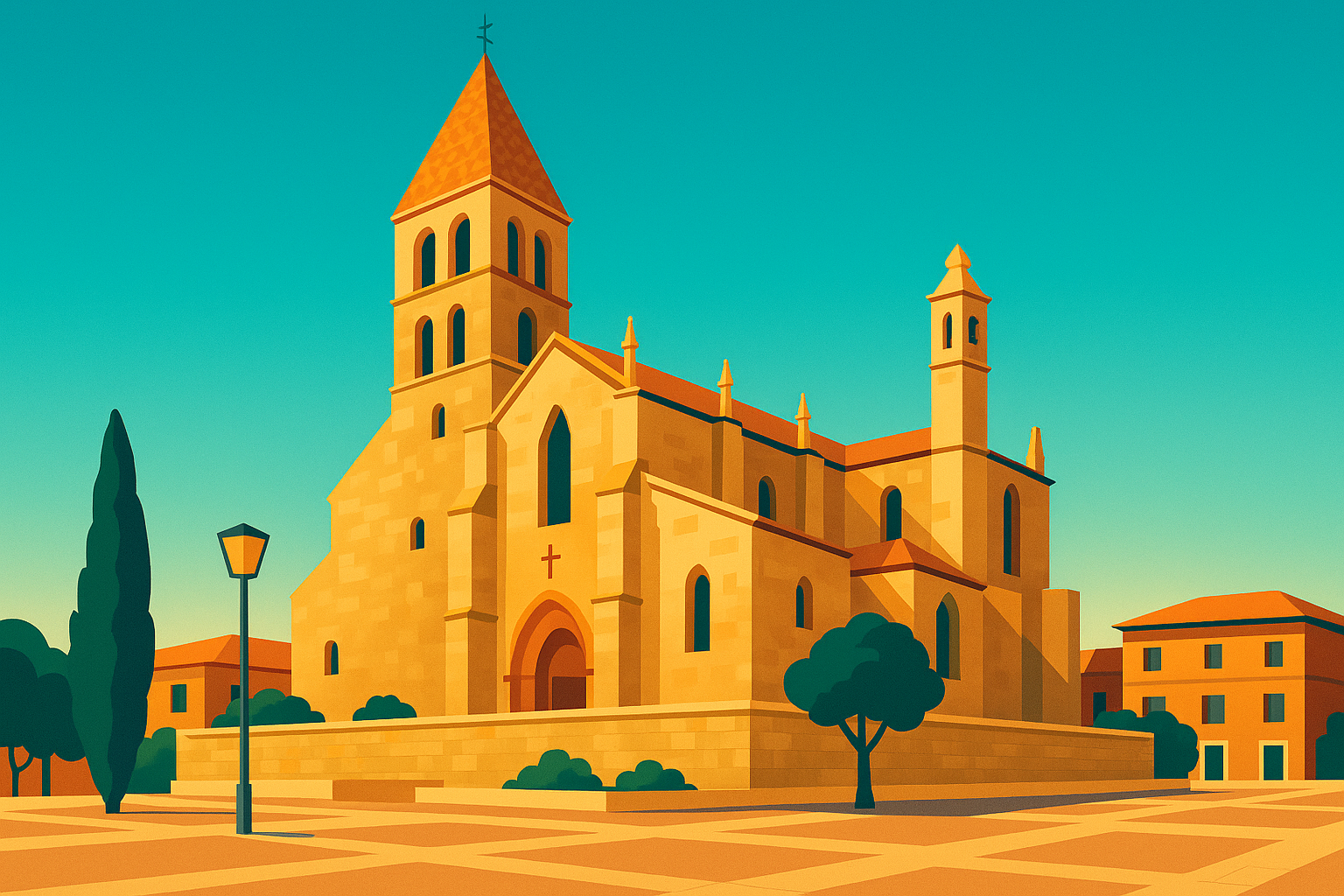
Iglesia de Santa Eulalia
Discover the most beautiful coves
To explore the hidden coves and move freely around the island, a car is your best solution. We recommend booking one in advance to secure the best price and not miss a single corner of paradise.
🔍 Find the perfect car for youThe Other Cathedral: Palma’s Royal Church of the Conquest
In the intricate, sun-drenched labyrinth of Palma’s old town, the magnificent Cathedral of Santa Maria, ‘La Seu’, commands the skyline, its golden sandstone soaring above the sea. It’s an icon, a landmark of breathtaking scale. Yet, just a few steps away, nestled in a lively square that beats as the city’s true civic heart, stands a church of equal, if not greater, foundational importance. This is the Iglesia de Santa Eulàlia, Palma’s oldest parish church and the quiet protagonist of the island’s complex, layered history.
While La Seu draws the eye, Santa Eulàlia holds the city’s memory. It is one of the four original parishes founded immediately after the Christian conquest of Mallorca, a direct link to the city’s rebirth. Architecturally, it shares a rare distinction with the great Cathedral: it is one of only two Gothic churches in Palma built with a grand, three-nave floor plan.
To visit Santa Eulàlia is to bypass the main tourist thoroughfare and access the city’s origin story. This was the de facto cathedral for the nascent Kingdom of Mallorca, a stage for royal coronations long before La Seu’s vaults were complete. It is a palimpsest of the city’s identity, a building that bears witness to both the triumphal pageantry of its conquerors and the deep, hidden traumas of its most segregated communities.
Why Visit? The Soul of Old Palma
The experience of Santa Eulàlia begins with a profound sensory shift. You’ll find its entrance on the eponymous plaza, a charming, intimate square humming with life. Here, locals and visitors gather at cafe terraces, the clinking of coffee cups and lively conversation filling the air. It’s the perfect spot to enjoy a traditional *llonguet* sandwich and watch the city go by.
Then, you step through the doors. The bright, communal bustle vanishes, replaced by a vast, cool, and echoing silence. The interior is a peaceful sanctuary, a cavernous space defined by the soaring grace of elegant, octagonal columns that branch into high, ribbed vaults. The light is different here—filtered, solemn, and historic. But the atmosphere is not merely peaceful; it is heavy with a profound duality.
This building embodies two conflicting identities. It is, first and foremost, the “Church of the Conquest,” a muscular symbol of Catalan victory, deliberately named for the patron saint of Barcelona. Yet, it is also the “Church of the Conversion,” a place of deep social trauma and religious persecution. It was within these very walls that Palma’s Jewish community was forcibly baptized after the pogroms of 1391. As a visitor, you do not just walk through a Gothic hall; you walk through a space defined by both royal celebration and harrowing memory.
A History Forged in Conquest and Conversion
Santa Eulàlia’s 800-year history is a mirror of Palma itself, marked by three pivotal chapters: its militant foundation, its royal mandate, and its hidden social chronicle.
The Church of the Conquest (Post-1229)
The church’s story begins with the conquest. In 1229, Jaume I of Aragon (James I) captured Madina Mayurqa from the Moors, initiating the Christian-Catalan era of the island. A new Christian city required new sacred foundations. In 1236, construction began on Santa Eulàlia, built directly over the ruins of a 10th-century mosque. This was a deliberate and powerful act of religious and political supplantation, a physical declaration of a new order.
The choice of name was equally symbolic: Saint Eulàlia, a 13-year-old virgin martyr from Barcelona. By dedicating Palma’s first great parish to the patron saint of their capital, the Catalan conquerors were stamping their own identity onto the new city, binding it forever to their homeland.
The Royal Stage (1276)
While Jaume I had ordered the construction of the massive new cathedral, La Seu, it was a generational project that would not be functional for decades. The new, independent Kingdom of Mallorca needed an immediate and magnificent stage for its most critical state ceremonies.
Santa Eulàlia, as the largest and most important parish in the 13th-century city, was the only logical choice. It became the acting cathedral. In 1256, the island’s General Council gathered here to swear loyalty to the heir, the future Jaume II. The church’s defining moment came in 1276, when Jaume II was crowned King of Mallorca within its walls. This event cemented Santa Eulàlia’s status as the official royal church of the new kingdom, the true setting for the birth of Mallorcan monarchy.
The Hidden Chronicle: The Xuetas of Palma
This triumphal history masks a darker, more complex narrative. In 1391, a violent anti-Jewish rebellion swept the island, culminating in a massacre in Palma’s Jewish quarter, the *Call*. Hundreds were killed, and the surviving Jewish community was given a stark choice: flee or convert.
Santa Eulàlia was the site chosen for this mass forced conversion. The city’s remaining Jewish population “entered the Church of Santa Eulalia and left baptized”. These *conversos*, and their descendants, became known as the Xuetas (pronounced *Chuetas*). Despite their new faith, they were segregated, distrusted, and socially marginalized for centuries, often forced into specific trades like silversmithing.
The church itself holds a physical testament to this segregated history. The side door on Carrer Esglesia de Santa Eulalia was known as the “silversmiths’ door”. Just inside, you will find the Chapel of Saint Eligius, the patron saint of blacksmiths and silversmiths. This was the guild chapel for the Xueta community. It stands as a powerful, poignant, and heartbreaking symbol: the community that was forcibly converted within the church was then relegated to its own chapel, a physical marker of their enduring, segregated identity.
On a much lighter note, the church even boasts a literary cameo, appearing in Jules Verne’s 1895 novel *Clovis Dardentor*. In a humorous scene, the protagonist’s runaway carriage careers through the city and bursts into the church, dramatically interrupting a service.
A Tale of Two Gothics: Architecture and Art
The church’s architecture tells its own story of time, rupture, and repair—a fascinating tale of two distinct Gothic styles.
The Catalan Gothic Core
The interior is a magnificent example of 13th and 14th-century Catalan Gothic architecture. Unlike the single-nave churches common in Palma, Santa Eulàlia was built with a grand, three-nave plan, a feature it shares only with the Cathedral. The central nave is flanked by two lower side naves, with chapels set between the external buttresses. The entire space is defined by its sense of verticality, with tall, elegant octagonal columns rising to a serene, rib-vaulted ceiling.
The 1851 Scar and the Neo-Gothic Facade
The building’s medieval purity was ruptured on May 15, 1851, by an earthquake that struck Mallorca. This same tremor caused significant damage to the Cathedral, prompting Gaudí’s later intervention there. At Santa Eulàlia, the original Gothic facade was catastrophically damaged.
What stands today is a Neo-Gothic reconstruction, built between 1894 and 1903. This 19th-century “mask” is grand, but distinctly different from the authentic medieval work. To appreciate the contrast, compare the main facade with the original Gothic portals on the side streets. In a remarkable act of preservation, the magnificent 15th-century rose window was salvaged from the original collapsing facade and meticulously incorporated into the new one, serving as a luminous bridge between the centuries.
Sentinels and Treasures Within
The exterior walls and balconies are guarded by a host of medieval gargoyles. These mysterious monsters—dragons, harpies, and other grim figures—were not merely decorative; they were apotropaic symbols, believed to ward off evil spirits.
Inside, the side chapels house a collection of priceless artistic and historical treasures:
- The High Altar: The main altarpiece is a spectacular, overwhelming Baroque creation by the Dominican friar Albert de Burgunyó. Its gilded, dramatic forms are a stark contrast to the austere Gothic structure that contains it.
- The Historic Pulpit: A must-see relic for any visitor. This is the very pulpit from which the famed Valencian preacher Saint Vincent Ferrer, known as the “Angel of the Apocalypse,” delivered his fiery sermons in 1413. A commemorative stone and his portrait mark this significant event.
- Key Medieval Panels: The church preserves crucial examples of Mallorcan medieval art, including the altarpieces of Santa Lucía and Santa Bárbara, the *Salvator Mundi* panel by Francesc Comes, and a splendid *Dormition of the Virgin*.
- The Christ de la Conquesta: In one chapel rests the “Christ of the Conquest,” a 13th-century image of Christ. According to tradition, this foundational relic was donated to the church by Jaume I himself, a lucky charm carried by the conqueror.
Planning Your Visit: Hours, Prices, and Practicalities
Visitor information for Santa Eulàlia is a common source of confusion, as the church operates with two different schedules and fee structures. Here is a clear breakdown to help you plan.
Church Interior vs. Terrace Visit: A Clear Guide
There are two ways to experience the church, and it’s crucial to understand the difference:
- The Church Interior (For Worship and Brief Visits): Access to the main nave for prayer or a quiet look is Free. The church is open for this purpose around its religious service times.
- Hours: Monday to Saturday from 9:00–10:30 and 17:00–20:00.
- The Tourist Visit (Terraces & Belfry): The primary tourist attraction, which includes the climb to the 50-meter-high belfry and rooftop terraces, has a separate admission and schedule.
- Admission: €5 per person.
- Hours: This visit is only available from April to October. Monday to Friday from 10:00–13:00 and 16:00–18:00.
- Important: The terraces are Closed from November to March.
For the best value, consider the Spiritual Mallorca (SM) Card. For approximately €16, this pass includes access to the Santa Eulàlia terraces plus five other major religious sites, including the Palma Cathedral, the Santuari de Lluc, and the Claustro de San Francisco.
A thorough visit to the church interior takes about 45 to 60 minutes. To fully appreciate the interior and complete the terrace climb, allow a comfortable 90 minutes.
Getting to Santa Eulàlia
The church is ideally located in the heart of Palma’s charming historic centre and is best reached on foot.
- Address: Plaça de Santa Eulàlia, 2, 07001 Palma.
- On Foot (Recommended): The church is situated in a largely pedestrianized area. It is an easy, 1-minute walk from the Plaça de Cort (Palma’s Town Hall) and a scenic 5 to 7-minute walk from the Cathedral (La Seu).
- By Public Transport (EMT Bus): The closest stop is 662-Pl. de Cort (a 1-minute walk), served by lines 4 and 35. A more common tourist option is the 453-Pl. de la Reina – Catedral stop (a 7-minute walk), which is served by the major Line 25, connecting to the airport and Playa de Palma.
- By Car: Driving to the church is strongly discouraged. Parking in the old town is exceptionally challenging. The best option is to park in the large underground garage at Parc de la Mar (by the Cathedral) and walk 10-12 minutes to the church.
Facilities and Accessibility
It is important to manage expectations, as Santa Eulàlia is a historic monument and an active place of worship, not a modern tourist complex.
- Restrooms: There are no public restrooms available within the church building. Visitors are advised to use the facilities at one of the many cafes or restaurants in the surrounding plaza.
- Accessibility: The main nave of the church is flat and wheelchair accessible. However, the main tourist attraction—the terraces and belfry—are NOT accessible. This part of the visit requires a climb up a narrow spiral staircase, making it unsuitable for those with mobility issues.
- Audio Guides: The church does not provide its own official audio guide.
Making the Most of Your Time
For the best experience, timing is key.
The Best Time to Visit for Peace and Pictures
For tranquility, visit on a weekday morning, right when the terraces open at 10:00. At this time, it is possible to experience the peaceful atmosphere and explore the chapels without the large tourist crowds that congregate at the nearby Cathedral.
For photography, the late afternoon offers the most dramatic light. During this “Golden Hour,” the sun streams through the magnificent 15th-century rose window and the other stained-glass panels, casting a kaleidoscope of colors onto the serene octagonal columns.
The Best Photo Spots
- The Terrace View (The “Insider Shot”): This is the single best shot. The 50m-high belfry provides an intimate, urban panoramic. Instead of the wide-open sea views from La Seu, this vantage point looks over the intricate maze of medieval rooftops and down into the hidden courtyards and cloisters of the old city, most notably those of the Basílica de Sant Francesc.
- The Gargoyles: From the terrace, a zoom lens can capture the mysterious and grim gargoyles that adorn the upper levels.
- The Facade: A wide-angle shot from the plaza, centered on the massive 15th-century rose window set within its 19th-century Neo-Gothic frame.
- The Interior: An interior shot capturing the kaleidoscope of colors cast by the stained-glass windows as the light hits the elegant octagonal pillars.
Beyond the Church: Exploring the Heart of Palma
Santa Eulàlia is the perfect anchor for a walking tour of Palma’s historic and civic core.
- The “Civic Power” Triangle: This 1-hour loop explores the heart of old Palma. Start at Plaça de Cort (1 min walk) to see the Town Hall and its ancient olive tree. Explore Santa Eulàlia, then walk 5 minutes to the magnificent Basílica de Sant Francesc and its Gothic cloister. The terrace visit at Santa Eulàlia provides a perfect link, offering a unique bird’s-eye view down into these cloisters.
- Culture and Cuisine: After visiting the church, walk two minutes to the Carrer de Can Verí. This elegant lane is home to several of Palma’s most important contemporary art galleries. Conclude your visit back in the Plaça de Santa Eulàlia at one of the terrace cafes, trying a *llonguet*—a bread roll and sandwich unique to Palma.
A Final Word
Visiting the Iglesia de Santa Eulàlia is not just about seeing another of Palma’s beautiful churches; it’s about understanding the city’s blueprint. It is the architectural, political, and social “Rosetta Stone” of Palma de Mallorca, a place where the kingdom’s history was written—both its public triumphs and its most painful, hidden chronicles.
Do not skip the terrace climb. While the Cathedral’s terraces show you the glory of the sea, Santa Eulàlia’s terraces show you the secret heart of the city.
From that vantage point, you can look down upon the tangle of streets that once formed the *Call* and the silversmiths’ district. You are not just seeing a pretty view; you are seeing the very geography of the Xueta history, connecting the Chapel of St. Eligius inside with the community it served outside. It’s a perspective that transforms a simple visit into a profound understanding of Palma.