
Palau March Museum
Discover the most beautiful coves
To explore the hidden coves and move freely around the island, a car is your best solution. We recommend booking one in advance to secure the best price and not miss a single corner of paradise.
🔍 Find the perfect car for youThe March Palace: Palma’s Hidden Treasury of Giants and Miniatures
In the epicentre of Palma’s historic power, the visitor stands dwarfed by two icons: the golden-stone immensity of La Seu Cathedral and the royal battlements of the Almudaina Palace. Tucked beside them, so close it is often mistaken for a state annex, is a third, quieter palace. This is the Palau March, and it is not a relic of medieval kings. It is a 20th-century statement of a new kind of power—finance—built by the formidable March family.
Today, this former residence is not a public gallery but a magnificent private treasure box, converted into the Museu Fundación Bartolomé March by the founder’s son, Bartolomé March Servera. A visit is a journey of sharp, fascinating contrasts. The experience moves from the thunderous, floor-to-ceiling allegorical murals of Josep Maria Sert to the hushed, intricate, micro-detailed world of a 2,000-piece 18th-century nativity scene. This journey culminates on an open-air terrace, where works by Auguste Rodin and Henry Moore are set against the Mediterranean sky. The Palau March is a refuge for those seeking a contemplative escape from the crowds next door, offering a rare and intimate glimpse into the mind of one of Spain’s great 20th-century collectors.
Why Visit the Palau March? An Atmosphere of Private Splendour
The atmosphere inside Palau March is a deliberate, dramatic shift from its neighbours. Where La Seu Cathedral inspires a sacred, cavernous awe, and the Almudaina Palace tells a story of martial, medieval history, the Palau March feels like a stately, opulent, and intensely private home. The air is still, the halls are polished and hushed, and every object feels curated with a singular, personal taste. You are not jostled by crowds but invited to contemplate.
The building itself is a profound symbol of a new order. Commissioned by the family patriarch, Juan March Ordinas, it was constructed between 1939 and 1945. The timing is critical: construction began the very year the Spanish Civil War ended. Its location is an audacious statement. By placing this grand residence shoulder-to-shoulder with the Royal Palace (the Crown) and the Cathedral (the Church), the March family cemented their 20th-century financial dynasty as the third pillar of Mallorcan power. This regionalist style, borrowing from Mallorcan and Italian Baroque traditions, was not a home built in quiet deference; it was a palace built to assert. For the visitor, this translates to a feeling of being a privileged guest, wandering through a space where every detail tells a story of ambition, taste, and influence.
The March Dynasty: Solving Palma’s Art Riddle
A visit to the Palau March requires solving Palma’s most common cultural riddle: “Which March museum is this?” The confusion between the city’s two March foundations is the single greatest hurdle for visitors, yet understanding the difference is key to appreciating what makes this palace so unique.
The story begins with the patriarch, Juan March Ordinas (1880-1962). Known as the “richest man of Mallorca” and founder of Banca March, he was the financier who commissioned this building, the Palau March, as his opulent family residence. Separately, he established the Madrid-based “Fundación Juan March” in 1955.
The magnificent collection inside the palace, however, belongs to his son, Bartolomé March Servera (1917-1998). Bartolomé was the aesthete of the family. Cosmopolitan, educated in Palma and London, he was a passionate art lover and an “expert bibliophile.” His passion was fostered by his mother, Leonor Servera Melis, a woman of “great character and sophisticated tastes.” It was Bartolomé who, over his lifetime, assembled the eclectic art seen today: the modern sculptures, the rare maps, and the sprawling nativity scene. In 1975, he established the Fundación Bartolomé March Servera to manage and display his personal collection within the family palace.
This history provides the crucial “insider tip” for navigating Palma’s art scene:
- Fundación Bartolomé March (This Museum): Located at Carrer del Palau Reial, 18. It houses the Sert Murals, the Neapolitan Belén, and the Rodin/Moore sculptures. This museum has an admission fee of approximately 10.00 EUR.
- Museu Fundación Juan March (The Other Museum): Located at Carrer de Sant Miquel, 11. It houses 20th-century Spanish masters like Picasso, Miró, and Dalí. Admission to this museum is Free.
Knowing this distinction transforms a confusing visit into a clear choice. The Palau March is not a gallery of Spanish masters; it is a curated journey through the personal, and perhaps more eccentric, passions of its cosmopolitan founder.
Inside the Treasure Box: The Five Remarkable Collections
The palace, designed by architect Luis Gutiérrez Soto, is a vessel for five distinct and remarkable collections, each revealing a different facet of Bartolomé March’s personality.
The Giants: Confronting the Murals of Josep Maria Sert
The first and most overwhelming experience is the confrontation with the murals of Josep Maria Sert (1874-1945). Sert was one of the 20th century’s most sought-after—and controversial—muralists, a favourite of European and American elites who famously replaced Diego Rivera’s work at Rockefeller Center.
In the Palau March, his work dominates the main staircase. The vast vault is covered in a grand, allegorical mural divided into four parts. Three represent virtues (audacity, reason, and inspiration), while the fourth allegedly embodies those qualities in the form of Sert’s patron, Juan March. The spectacle continues in the music room, where Sert created a fantastical plaster trompe l’oeil decoration imitating swagged curtains, inset with circus performers, all beneath a ceiling of painted hot-air balloons. His style is often described as “grandiloquent,” using a “Goyaesque expressionism” and an “inky” monochrome or sepia palette (grisaille) that gives the paintings a powerful, sculptural, and deeply theatrical quality.
The Moderns: Art and Architecture in Dialogue on the Sculpture Terrace
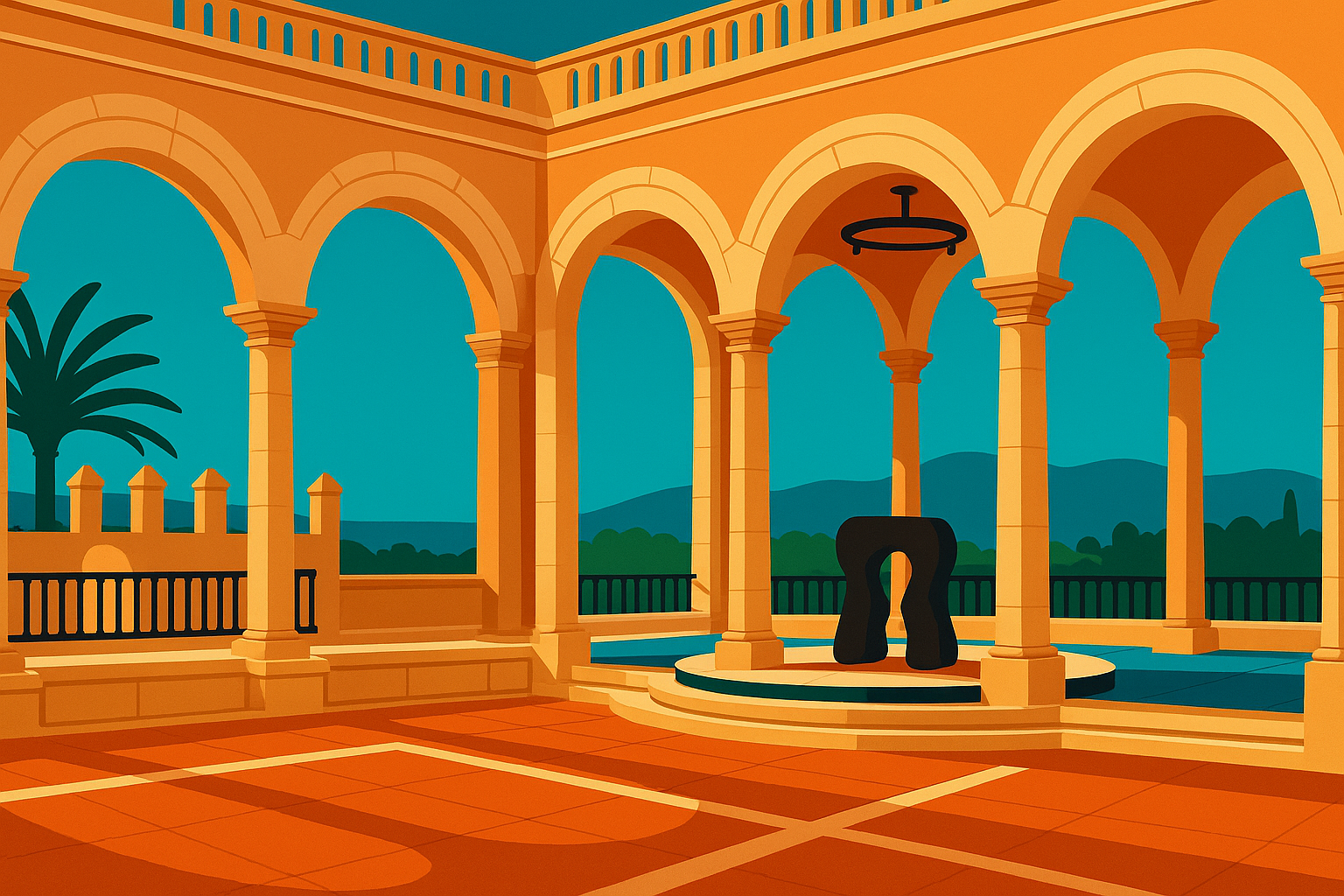
From the dramatic, dark interior, the visit transitions to the bright, open-air “courtyard of honour” and sculpture terrace. This is perhaps the palace’s most famous feature. Here, Bartolomé March assembled a superb collection of modern sculpture, anchored by 20th-century masters like Auguste Rodin, Henry Moore, Barbara Hepworth, and Eduardo Chillida.
The genius of the curation lies not just in the works themselves, but in their dialogue with the surroundings. The terrace offers stunning views, positioning the visitor to see a 20th-century abstract form—a perforated Barbara Hepworth, for example—directly framing a 14th-century Gothic buttress of the Cathedral next door. It creates a visual bridge, a conversation between the two great eras of Mallorcan power: medieval faith and 20th-century modernism.
The Miniatures: The Astonishing World of the Neapolitan Belén
The collection’s greatest surprise is the 18th-century Neapolitan “belén,” or nativity scene. This is no small Christmas display. Driven by his mother Leonor’s “sophisticated tastes,” Bartolomé March collected almost 2,000 individual pieces. The term “nativity scene” is misleading. In the 18th-century Neapolitan tradition, the nativity was a “pretext to depict the people of the villages with clothing and accessories… taken from life.”
The March collection, accordingly, features not just angels and kings, but shepherds, farm animals, and bustling market scenes. You are not looking at a purely religious object; you are observing a 2,000-piece, three-dimensional ethnographic diorama of 18th-century Neapolitan society, from the highest aristocrat to the humblest fishmonger. Its quality is so high that it was loaned to the Royal Palace in Madrid in 2008, attracting over 70,000 visitors.
Do not rush past the Belén Napolitano. This 2,000-piece collection is one of the museum’s greatest treasures, a masterpiece of ethnographic detail capturing the entirety of 18th-century Neapolitan life in breathtaking miniature.
The Hidden Gem: Repatriating Mallorcan Cartography
This collection reveals the bibliophile soul of Bartolomé March. The museum houses a collection of 14th and 15th-century Mallorcan navigation charts, described by the foundation itself as “one of the finest in the world.” During this period, Mallorca was a global powerhouse of cartography. These “portolan charts,” known for their “technical perfection and… aesthetic value,” were the high-tech GPS of the Mediterranean. Most had left the island over the centuries. Bartolomé March, the “expert bibliophile,” painstakingly repatriated these scattered maps, restoring a core piece of Palma’s scientific and artistic heritage.
The Scholarly Soul: The Bartolomé March Servera Library
The final piece of the founder’s identity is the library. Open to the public since 1970, this is a serious research institution specializing in Balearic themes. It holds over 2,000 manuscripts and 60,000 volumes dating from the 14th century to the present. While most visitors will not use it for research (it has separate, limited hours), its presence reinforces the scholarly, contemplative atmosphere that defines the entire palace.
Planning Your Visit: Practical Information
Opening Hours and Admission
Planning a visit requires attention, as official information can be inconsistent across different platforms. The foundation’s own website indicates the museum is open Monday to Saturday, from 10:00 a.m. to 5:30 p.m. However, travellers should be aware that other official pages and third-party sites sometimes list an earlier 5:00 p.m. closing or a 2:00 p.m. closing on Saturdays. Some sources also suggest seasonal hours (e.g., closing at 2:00 p.m. from November to March).
The safest strategy is to rely on the 10:00-17:30 window but to check the official website on the day of your visit. The last admission is 30 minutes before closing. The museum is closed on Sundays and all public holidays.
The official website does not list its admission price. However, multiple independent tourism and booking sites consistently cite the adult admission price as 10.00 EUR. While older guides may mention lower prices, this is the accepted current rate.
Ideal Duration
While some reviews suggest a visit can be as short as 30 minutes, this does a disservice to the collections. To properly absorb the scale of the Sert murals, explore the 2,000-piece belén, and enjoy the sculpture terrace, a visit of 60 to 90 minutes is highly recommended.
How to Get There
The museum is located in the most restricted, historic heart of Palma at Carrer del Palau Reial, 18, immediately adjacent to the Royal Palace of La Almudaina.
The ideal way to arrive is on foot. The museum is a very short, signposted walk from Palma’s primary landmarks. From the base of the Cathedral or the tranquil S’Hort del Rei gardens, one simply walks up Carrer del Palau Reial.
For those using public transport, the most convenient bus stop for the entire historic complex is Plaça de la Reina / Catedral. This stop is served by key EMT Palma bus lines, including Line 25 (from s’Arenal) and Line 35 (from the Aquàrium). From the stop, it is a scenic 5- to 7-minute walk.
Driving directly to the museum is not recommended due to the ACIRE (restricted access) zones in the old town. The nearest large public underground car park is Parc de la Mar, located beneath the artificial lake in front of the Cathedral. From this garage, it is a 10-minute walk.
Facilities and Accessibility
The foundation’s most significant public-facing service is its Research Library, a world-class institution for Balearic studies. It is open for consultation but operates on more restrictive hours than the museum. Other services include Guided Visits, which should be booked in advance.
Visitor accessibility, however, is a critical area of conflicting information. Some booking sites state the experience is “Not suitable for wheelchairs,” while others use a “Wheelchair accessible” tag. The building is a 20th-century historic residence, not a modern, purpose-built museum, and such structures are often difficult to retrofit. Given this direct contradiction, accessibility is not guaranteed. Visitors with mobility impairments are strongly advised to call the foundation directly at +34 971 71 11 22 to confirm the current status before planning a visit.
When to Go: The Secret to a Serene Visit
While Palma is most pleasant in the shoulder seasons (April-May, September-October), the key to a good visit at Palau March is the time of day. The museum is physically shadowed by the two largest attractions in Mallorca, which are overwhelmed by tour buses and cruise ship excursions precisely at their 10:00 a.m. opening.
Therefore, the worst time to visit is 10:00 a.m. The best strategy is to visit either mid-morning (around 11:30 a.m.), after the initial wave of tourists is safely inside the other two attractions, or in the late afternoon (after 3:00 p.m.), when day-trippers have begun to depart. This allows for the Sert murals and the quiet terrace to be enjoyed as intended.
Beyond the Palace: An Art Connoisseur’s Day in Palma
The Palau March is the perfect starting point for a day of artistic exploration. Its most obvious neighbours are the Royal Palace of La Almudaina and La Seu Cathedral. For a high-value, cohesive art-focused day, combine your visit with two other key institutions:
- Morning: Start at Fundación Bartolomé March (Palau March) to see the Sert murals and the Rodin/Moore sculptures.
- Midday: Take the 10-minute walk to the other March foundation, the Museu Fundación Juan March (at Carrer de Sant Miquel), for its free-entry collection of 20th-century Spanish masters, including Picasso, Miró, and Dalí.
- Afternoon: Finish at Es Baluard Museu d’Art Contemporani to see contemporary works by island-connected artists like Miquel Barceló. This creates a chronological journey through 20th-century art in Palma.
Capturing the Palace: Best Photo Spots
The palace offers several unique photographic opportunities that tell its story.
The Terrace (“The Money Shot”)
This is the definitive photo spot. The best composition is achieved by standing on the terrace and using the modern sculptures by Moore, Hepworth, or Chillida as a foreground framing element. In the background, capture the Gothic architecture of the Cathedral or the sweeping views of the Bay of Palma. This juxtaposition of 20th-century abstract art with 14th-century Gothic power is the visual summary of the entire collection.
The Sert Staircase
Standing at the bottom of the main staircase and shooting straight up with a wide-angle lens is the only way to capture the “grandiloquent,” overwhelming, and dramatic scale of Sert’s allegorical vault.
The Courtyard of Honour
The elegant, columned “courtyard of honour” and its “Renaissance window” provide a more classic, architectural shot of the palace’s unique neo-Baroque style, capturing the essence of its stately ambition.