
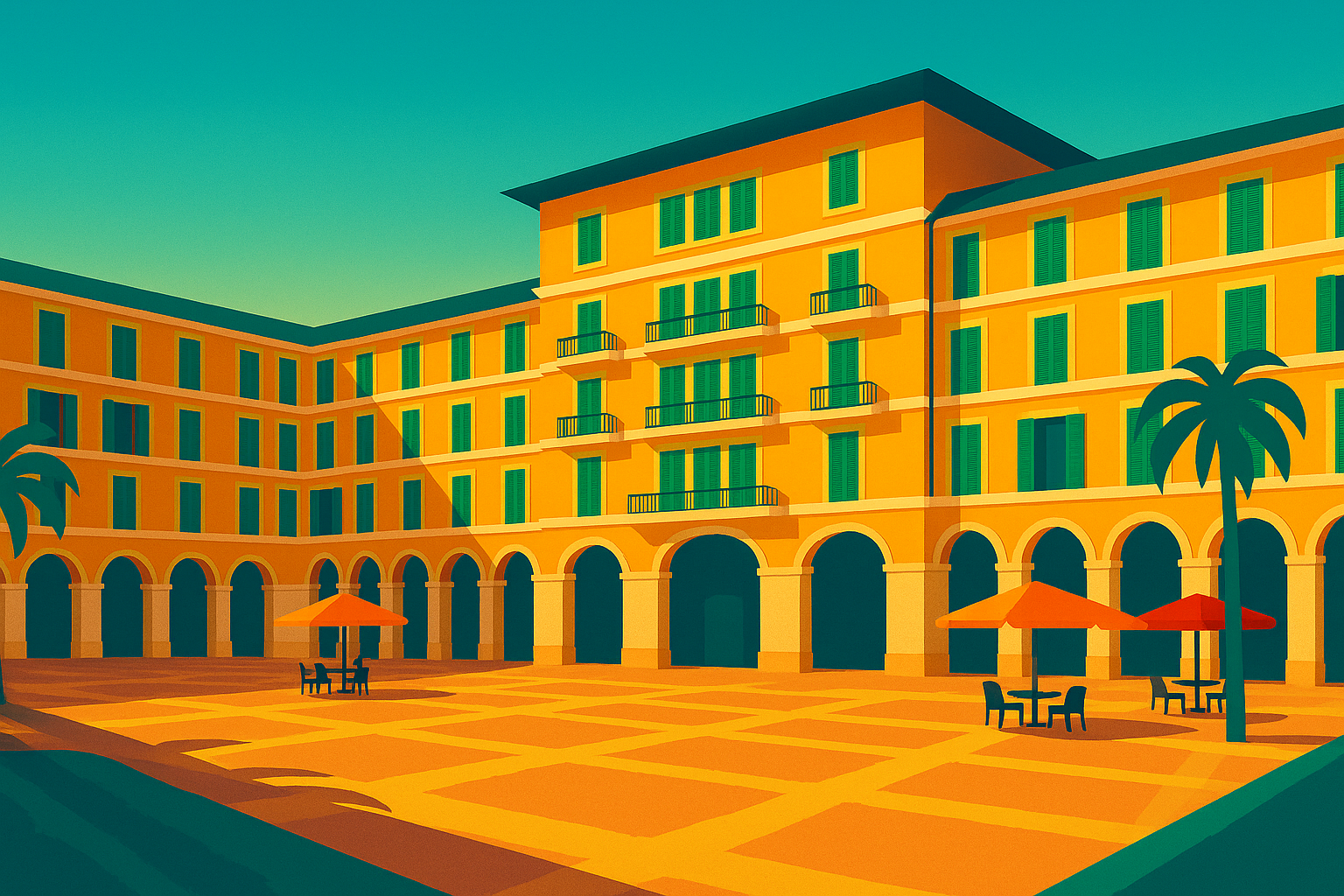
Plaça Major, Palma de Mallorca
Discover the most beautiful coves
To explore the hidden coves and move freely around the island, a car is your best solution. We recommend booking one in advance to secure the best price and not miss a single corner of paradise.
🔍 Find the perfect car for youThe Heart of the Labyrinth: Plaça Major and the Medieval Soul of Palma
To stand in Palma’s Plaça Major is to find yourself on the city’s most vibrant stage, a grand, open-air living room where the classic Mediterranean good life is in full swing. The senses are immediately engaged. Uniform, ochre-coloured buildings rise on all sides, their rhythmic rows of charming green shutters creating a sense of harmony and order. Below, expansive arcaded walkways offer cool shade and passage, their arches framing the bustling scene within. The air hums with the sound of street performers, the clatter of cutlery from café terraces, and the constant murmur of one of Palma’s busiest public spaces. It feels bright, welcoming, and unequivocally modern.
Yet, this magnificent 19th-century stage was deliberately built to mask a profound historical scar. This precise location was not always a place of leisure and commerce. For centuries, it was the site of the Convent of San Felipe Neri, a building that became the dreaded headquarters—the very see of the infamous Spanish Inquisition in Mallorca. The ground beneath the souvenir stalls and sun-soaked tables is, in fact, one of the most solemn in the city, a place of terror and brutal religious control.
This central contradiction is the key to truly understanding Palma. The Plaça Major is not the final destination; it is the compass. It is the 19th-century antechamber, a deliberate architectural statement grafted onto a far older, more complex world. This guide will lead you from this grand public square into the labyrinth of the Casco Antiguo—the true medieval streets, the silent Jewish Quarter, the ancient Moorish remnants, and the hidden noble patios that hold the authentic soul of the city.
The Atmosphere: Palma’s Grand Living Room
The Plaça Major functions as the city’s social and cultural pulse point, a typically Spanish grandiose central square where life is lived out in the open. Its modern identity is defined by three primary roles. First, it is a commercial hub. The continuous covered corridor on the ground floor is lined with a wide variety of cafes, restaurants with large terraces perfect for people-watching, and artisan shops tucked into its shaded recesses.
Second, it is a cultural stage. The square regularly hosts a lively artisan market, a perfect place to find local crafts from Mallorcan leather goods to handmade ceramics. This is supplemented by a constant, rotating cast of street performers, from musicians and living statues to caricaturists who animate the space with energy and creativity. Third, it is a seasonal anchor, transforming completely to host the city’s main Christmas and Easter markets, becoming a focal point for civic celebration.
However, the symbolism of this atmosphere is as important as the activity itself. The 19th-century planners who designed the square were performing a deliberate act of urban sanitation. By demolishing the dark, foreboding convent that housed the Inquisition, they were consciously replacing a symbol of terror with a new symbol of 19th-century modernity: commerce, public leisure, and bourgeois order. This perhaps explains the square’s dual nature. While it is a bustling hub of activity by day, some observers note it can fall eerily silent at night, as if the air of solemnity from its past has never fully lifted.
A History Written in Stone and Silence
The story of the Plaça Major is one of deliberate erasure and reinvention. To appreciate the bright, open space you see today, you must first understand the darkness it was built to replace.
From Inquisition to Intersection
For most of its medieval life, this area was dominated by the Convent of San Felipe Neri. Its history took a dark turn, however, when the site became the headquarters of the Tribunal of the Holy Office of the Inquisition in Mallorca. From the 15th century until its final abolishment, this was the epicentre of religious and state control on the island. This was no passive administrative building; it was an active centre of terror, known for its public penance rituals known as *autos-da-fé* and, according to some historical sources, public executions.
This history is inextricably linked to the medieval Jewish Quarter, the Call Major, located just a short walk away. The Inquisition’s primary targets were *conversos*—Jews who had converted to Catholicism but were suspected of secretly practising their ancestral faith. The proximity of the Inquisition’s headquarters to the Call Major is a chilling reminder of the fear that once permeated these now-peaceful streets.
The site’s transformation began almost immediately after the Inquisition was suppressed. The convent was torn down in 1823. By 1825, work had begun on the grand, rectangular square we see today, a project of the Enlightenment designed to overwrite the past and create a modern public sphere. A final layer of modernization was added in 1969, when an underground shopping centre and car park were constructed beneath the square, completing its journey from a place of solemnity to one of pure commerce.
Beyond the Square: Your Gateway to the Medieval Labyrinth
The architectural experience of the Plaça Major is one of powerful contrast: the 19th-century order of the square itself versus the ancient, organic labyrinth it connects to. For the modern explorer, its true purpose is to serve as a gateway.
The Architecture of the Plaça: 19th-Century Uniformity
The square is a large, longitudinal rectangle defined by its enclosed, harmonious design. The facades are uniform, painted in warm ochre and yellow tones, creating a sense of unity. This is punctuated by the pleasing rhythm of charming green shutters and wrought-iron balconies. On the ground floor, a continuous portico, or covered corridor, is formed by stone arches that provide welcome shade and a traditional space for commerce.
Stepping into the Casco Antiguo
The Plaça’s main arteries—Carrer de Sant Miquel, Carrer de Colom, and Carrer del Sindicat—act as spokes that lead you directly from the 19th-century grid into the Barrio Vecchio. The transition is immediate and dramatic. One moment you are in a wide, bright, orderly square; the next, you are plunged into a maze of streets clearly hinting at an Arab past. This is the labyrinth you came to find: a world of narrow, quiet streets, cobblestone alleyways, and medieval houses where the city’s history is layered and visible at every turn.
The Silent Lanes of the Call Major
A critical part of this medieval world is the Call Major, the historic Jewish Quarter. Located just a stone’s throw from the Plaça, this area is a serene labyrinth of car-free lanes that offer a peaceful escape from the city’s bustle. Once a walled-in ghetto, its medieval urban plan survives in the narrow, dead-end alleyways that branch off its main streets, offering a direct window into the 14th-century city.
Palma’s Oldest Secret: The Banys Àrabs
Deeper within the Casco Antiguo, on Carrer de Can Serra, lies the oldest architectural layer of Palma: the Banys Àrabs, or Arab Baths. Dating to the 11th century, these baths are one of the few precious remnants of Palma’s Moorish past. The main hot room (*caldarium*) is a beautiful Byzantine-style structure with a cupola featuring five *oculi* (openings) that allowed light to filter in and steam to escape. This dome is supported by twelve columns, which were recycled from earlier Roman ruins, creating a miniature oasis that feels worlds away from the city outside.
The Hidden Palma: Unlocking the Aristocratic Patios
One of the most unique and overlooked features of the Casco Antiguo are its patios, the best-kept treasures of the Old Town. Hidden behind the grand, severe facades of medieval and Baroque mansions, these courtyards were the true hearts of aristocratic life from the 16th to 18th centuries. They were powerful symbols of prestige and wealth, where families conducted business and received guests. While many are private, several are open to the public and form a must-do itinerary:
- Can Balaguer: A short walk from Plaça Major, this former mansion is now a cultural centre. It is renowned for its impressive imperial staircase and imposing stone architecture.
- Casal Solleric: Situated on the elegant Passeig del Born, this 18th-century palace now serves as a contemporary art gallery. Its courtyard is a jewel of Rococo and neoclassical design.
The Modernista Shock: A Gaudí-esque Surprise
The final architectural experience is one of delightful contrast. The reserved 19th-century order of the Plaça Major serves as the perfect foil to the explosive Catalan Modernisme (Art Nouveau) buildings that erupted in its vicinity at the turn of the 20th century. The most dramatic example is Can Forteza Rey, located just off the square. Built in 1909 by an architect heavily influenced by Gaudí, the building is an architectural shock. Its facade is a riot of *trencadís* (broken tile mosaics), organic shapes, sinuous ironwork, and wild sculptures, including a hideous face staring down at the street, flanked by dragons.
Practical Guide: Planning Your Visit
Navigating to the Plaça is simple, but exploring the Old Town requires a specific strategy. The key is to embrace the area’s pedestrian nature and arrive prepared.
Getting There: Navigating to Palma’s Heart
The Casco Antiguo is a maze of narrow, cobblestoned streets, many of which are pedestrianized. Driving into this area is strongly discouraged. The best approach is to park on the perimeter or use public transport and explore entirely on foot.
- By Public Transport (EMT Bus): Palma’s city bus system, EMT, is excellent. The central hub for all city buses, intercity buses (TIB), and the train/metro system is the Intermodal Station at Plaça d’Espanya, an easy 10-minute walk from Plaça Major. For a more direct route, several EMT bus lines stop just a minute or two from the square, including lines 3, 7, 23, 25, and 107. The closest stops are Pl. D’En Coll or Plaça de Cort. A single ticket costs approximately 2€; be aware that credit cards are not accepted on board, so have small cash bills ready.
- By Car (Parking Strategy): While there is an underground car park directly beneath the square (Aparcament de la Plaça Major), it is best avoided. It is small, often expensive, and frequently full, especially during peak times. A much better strategy is to use one of the larger underground car parks on the perimeter of the Old Town:
- Saba Sa Gerreria: Located at Plaça de Sant Antoni, a simple 5 to 7-minute walk away.
- Parc de la Mar: Located south of the Cathedral, this is a larger car park and a perfect choice if your visit will also include La Seu. It is a scenic 10 to 15-minute walk to Plaça Major.
Opening Hours and Ideal Duration
The Plaça Major itself, as a public square, is open 24/7 and is free to enter. The commercial life within it follows typical Spanish hours, with shops and cafes generally open from 10:00 to 20:00. The artisan market, a key attraction, typically operates on Mondays, Tuesdays, Fridays, and Saturdays from 10:00 to 14:00.
While 30 to 60 minutes is enough to see the square itself, to fulfil the complete itinerary—to use the Plaça as a starting point to explore the medieval streets, the Call Major, and the hidden patios—you should plan for a minimum of a half-day. A full day is advised to do so without rushing.
Facilities and Accessibility
The Plaça is a bustling hub surrounded by a high density of cafes, bars, and restaurants. However, free public toilets are scarce. The most reliable options are to use the customer-only facilities in the many establishments.
It’s important to understand the “Accessibility Paradox.” The Plaça Major itself is highly accessible: it is flat, open, and the underground parking has elevators. However, the Casco Antiguo and its medieval streets are the opposite. The historic, uneven cobblestone streets are challenging for those with mobility issues.
When to Visit: Choosing Your Palma Experience
The atmosphere of the Plaça and the Old Town changes dramatically depending on the season and time of day.
- By Season: The shoulder seasons of spring and autumn are ideal, offering pleasant temperatures and fewer crowds. Summer is vibrant but can be very busy and hot. For a unique experience, visit during the special markets at Easter or Christmas.
- By Time of Day:
- Early Morning (08:00–10:00): The best time for photographers. The square is quiet and peaceful, allowing for unobstructed views of the architecture in the soft morning light.
- Late Morning / Afternoon (11:00–17:00): This is when the Plaça is at its most lively and bustling. The artisan market is open, and the street performers are active.
- Evening: The area remains lively for dining, but once the shops close, the square itself can empty out, taking on that eerie quiet noted by some visitors.
Capturing the Moment: Best Photo Spots
To capture the essence of Palma’s Old Town, move beyond simple snapshots and focus on these key compositions.
- The Classic Plaça Shot: Position yourself at the top of the main staircase to capture the expansive view of the yellow facades, green wooden shutters, and arched walkways.
- The Symbolic Shot: In Plaça de Cort, frame the gnarled, 600-year-old Olivera de Cort in the foreground, with the intricate Baroque façade of the Town Hall behind it. This single shot captures a symbol of peace set against the seat of civic power.
- The Architectural Detail Shot: At Can Forteza Rey, get close. Focus on the colourful ceramic tile mosaics (*trencadís*) and the grotesque face that bursts from the wall.
- The “Vie Medievali” Shot: The most atmospheric photos are found in the serene labyrinth of the Call Major (try Carrer de Montesión) during the golden hour, when the light catches the ancient stone.
- The “Hidden Palma” Shot: The most rewarding photo is inside a hidden patio. Step into the public courtyard of Can Balaguer to capture its dramatic imperial staircase without the crowds.
Conclusion: The Compass to Palma’s Soul
The Plaça Major is the perfect compass for Palma. It is the orderly, modern, and vibrant place to begin your exploration, enjoy a coffee, and orient yourself. Its bright, 19th-century calm should be appreciated, as should the dark, complex history it was built to conceal.
But the true Palma, the Barrio Vecchio you came to find, is not *in* the square. It is *through* it. The soul of the city is waiting for you in the silent lanes of the Call Major and behind the stone arches of a hidden aristocratic patio.
Put your map aside and embrace the ‘Get Lost (Intentionally!)’ philosophy. The medieval streets are not a single sight to be checked off a list; they are a labyrinth to be wandered.