
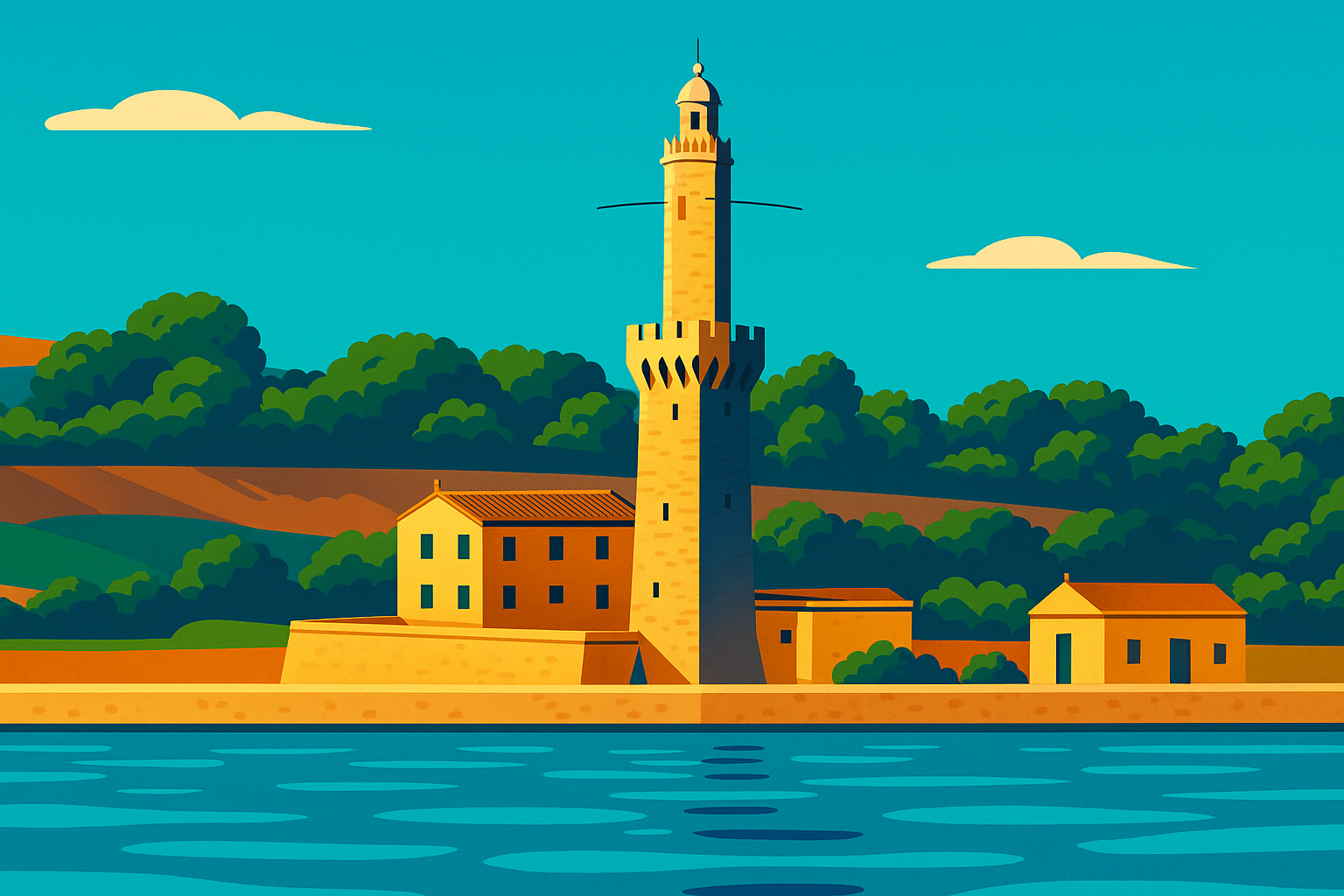
Portopí Lighthouse Palma
Discover the most beautiful coves
To explore the hidden coves and move freely around the island, a car is your best solution. We recommend booking one in advance to secure the best price and not miss a single corner of paradise.
🔍 Find the perfect car for youThe Porto Pi Lighthouse: Unlocking the Secrets of Palma’s 700-Year-Old Beacon
For most, the name “Porto Pi” conjures images of Palma’s oldest and largest shopping centre, a modern hub of commerce and convenience. Yet, standing quietly in its shadow, often overlooked by the bustling crowds, is the very beacon that gave the area its name: the Faro de Porto Pi. This is no mere picturesque tower; it is a living, breathing piece of world history, a silent sentinel that has watched over Palma’s harbour for over seven centuries.
The Porto Pi Lighthouse holds the distinction of being the second oldest in Spain, surpassed only by the ancient Roman Tower of Hercules, and is widely recognised as the third oldest operating lighthouse in the entire world. It has been a constant, unwavering presence, a flicker of light in the darkness for sailors navigating these waters since the Middle Ages.
A visit here, however, requires a complete resetting of expectations. This is not a casual tourist stop where you can simply buy a ticket and climb to the top. The lighthouse is a working beacon situated on restricted, active port land, adjacent to a naval base. Access is not a right; it is a rare privilege. The only way to step beyond the security gates is via a free, by-appointment-only guided tour. This tour doesn’t lead to the lantern for sweeping coastal views. Instead, it offers something far more profound: an expert-led journey into the extraordinary Exposition of Maritime Signals housed at its base, one of Europe’s most significant collections of its kind. This is an experience for the historian, the maritime enthusiast, and the curious traveller seeking to unlock one of Palma’s deepest and most rewarding secrets.
Why Visit the Faro de Porto Pi? A Journey into Living History
The Faro de Porto Pi does not stand on a windswept, romantic cliffside. Its setting is one of profound, functional beauty, a testament to its enduring purpose. It rises from the Dique del Oeste (West Breakwater), a working pier at the far end of Palma’s sprawling harbour. The atmosphere here is a sensory juxtaposition of ages. The ancient, unpainted stone of the 14th-century tower stands firm against the hum and thrum of the 21st-century port, a place of constant motion and energy.
From this unique vantage point, you are enveloped in the true workings of the Mediterranean. Massive cruise ships, so tall they dwarf the 38-meter tower, manoeuvre into their berths with surprising grace. High-speed ferries churn the turquoise water as they depart for Ibiza and the mainland. Above, gulls cry out on the sea breeze, and the air is thick with the sharp, clean smell of salt and the faint, powerful thrum of diesel engines. The lighthouse is a silent observer to it all, standing guard as it has for centuries.
It is a landmark woven into the fabric of the city, standing opposite the bustling Paseo Marítimo and gazing at its medieval “twin,” the Torre de Pareires, which guards the other side of the old harbour entrance. For the people of Palma, it is a constant, reassuring symbol of the city’s deep and unbreakable bond with the sea.
The Tower’s Turbulent Past: A 700-Year Timeline of Resilience
The story of the Faro de Porto Pi is one of adaptation, survival, and a curious conflict with its own protector. Its origins predate its function as a lighthouse. The structure was first documented in the last will and testament of King James II of Mallorca, dated September 12, 1300. It was built as the Torre de Senyals (Signal Tower), a crucial piece of the port’s infrastructure.
Its original purpose was twofold: to serve as a key defensive bastion at the harbour mouth and, more importantly, to act as the port’s communication hub. Using a complex system of horizontal masts and flags, it signalled the arrival, origin, and type of approaching ships—a vital function it remarkably continued to perform until 1971.
The tower’s transformation into a lighthouse was born from a 17th-century technological feud. In 1610, construction began on the formidable Castillo de San Carlos on the site of the original, smaller Porto Pi lighthouse. The castle was built to protect the port from relentless pirate attacks. However, an unforeseen problem arose: the “thunder of its cannons” and the resulting shockwaves “repeatedly caused the windows of the [original] tower to burst.” The beacon’s delicate optics and lantern simply could not survive in a battle zone.
The solution was ingenious. Between 1613 and 1617, the lighthouse’s lantern and function were relocated to the safer, sturdier, and nearby Torre de Senyals. The signal tower was heightened and retrofitted for its new role, and its light was “first lit” in 1617. It has been in continuous operation ever since. In 1983, its profound historical importance was officially recognised when it was declared a Monumento Histórico-Artístico (Historic-Artistic Monument).
What to Expect on Your Visit: The Exhibition and Architecture
A Vertical Timeline in Stone
Architecturally, the Faro de Porto Pi is a fascinating composite, a “vertical timeline” of Mallorcan history etched in stone. Its current form is the result of successive additions and reconstructions spanning 700 years, and you can read its story by simply looking up.
The tower can be seen in four distinct layers from the ground up:
- The Base: The original, crenellated medieval section from the 13th century, solid and unyielding.
- The Mid-Section: A quadrangular (square) section added in the 15th century, expanding its stature.
- The Upper-Section: An elegant octagonal body, built in the 17th century specifically to house the new optical system when the lantern was moved.
- The Crown: A final, truncated pyramid with parapets, a Neo-Gothic addition from a 1927 restoration that gives it its definitive silhouette.
The stone tower stands 38 meters (125 feet) high, with its light positioned at a focal height of 41 meters (135 feet) above sea level. Its modern characteristic is two white flashes every 15 seconds (Fl (2) W 15s), a rhythmic pulse visible for 18 to 22 nautical miles out at sea.
Inside the Beacon: The Maritime Signals Exhibition
While the tower itself is impressive, the true destination for visitors is the Maritime Signals Exhibition housed within its base. Opened in 2004, this is not a small, dusty collection of artefacts. It is a world-class exhibition, widely considered “one of the very best collections of maritime lighting material in Europe.”
The guided tour brings this remarkable technology to life. You will see the evolution of light, from humble 14th-century olive oil lamps to massive, intricate “weight-driven mechanics used to ‘wind up’ the lighthouse, like a clock.” The collection features enormous, beautifully crafted optics (lenses) that have all seen active service, including one so large it had to be airlifted by a US Navy helicopter from the nearby island of Dragonera.
Most notably, the exhibition contains the only reverb optics (which use mirrors instead of lenses) currently located in any Spanish lighthouse, a true technological relic. Just as importantly, the exhibition provides a human context, offering a “great insight into… what everyday life was like for lighthouse keepers and their families,” a poignant reminder of the isolated lives dedicated to keeping the light burning.
Planning Your Visit: Essential Information
Booking Your Free Tour
Access to this piece of history is a privilege, but one that is offered to the public for free. The visit, including the expert-guided tour, is managed by the Balearic Port Authority as a public service. However, access is strictly controlled and limited.
The exhibition is only open on:
- Wednesday to Friday: 10:00 to 15:00 (3:00 PM) and 16:00 to 19:00 (7:00 PM)
- Saturdays: 10:00 to 15:00 (3:00 PM)
- It is closed on Sundays, Mondays, and Tuesdays.
The most important rule is that visits are by advance appointment only. It is impossible to show up and be granted entry. Bookings must be made in advance, either through the online form on the official Fars de Balears website or by sending an email to fardeportopi@portsdebalears.com. Tours are offered in Catalan, Spanish, and English and are limited to a maximum of 20 people to ensure a quality experience.
Please remember: The visit to the exhibition does not include entry to the lighthouse tower itself. The focus is purely on the museum at its base. Based on the specialised nature of the collection, you should allocate 60 to 90 minutes for the full guided tour.
How to Get to the Faro de Porto Pi
Navigating to the lighthouse requires finding a specific security checkpoint, not a public-facing museum entrance. The visit does not begin at the tower. All visitors must meet their guide at the designated “visitor pickup and return point,” which is located at the security gate for the West Breakwater Access Control (Control Dique del Oeste) at the Port of Palma. From here, the group is escorted onto the restricted port land.
- By Public Transport (Recommended): The easiest way to arrive is by using Palma’s excellent EMT bus network. The key bus lines that stop at the nearby interchange are 1, 4, 20, and N1. The correct stop is “65-Àrea d’intercanvi Portopí”. This bus hub is directly in front of the Porto Pi Centro Comercial, just a 5-minute walk from the Dique del Oeste security gate.
- By Car: There is no designated public parking for the lighthouse. However, the adjacent Porto Pi Centro Comercial provides the perfect solution. The mall’s massive underground parking garage offers 2 hours of free parking, which perfectly accommodates the 60-90 minute tour duration. For GPS navigation, the best address to use is that of the shopping centre: Avenida Gabriel Roca 54, 07015 Palma.
Facilities and Accessibility
It is critical to understand that the Faro de Porto Pi is a working historic monument, not a commercial tourist site. There are no public facilities available. During the tour, you must “follow closely any instructions given by authorised staff” and are not permitted to “go outside the marked exhibition area” for safety reasons. Food and drink are not allowed inside the exhibition.
Treat the adjacent Porto Pi Centro Comercial as the official visitor centre. The lighthouse itself has no public restrooms, no café, and no shop.
Before arriving at the security gate for your tour, use the mall’s facilities, buy a bottle of water, or grab a coffee.
For visitors with mobility impairments, official sources do not provide specific information on wheelchair accessibility. Given the nature of the working breakwater and the ancient building, it is strongly advised to email the organisers at fardeportopi@portsdebalears.com when booking to confirm the accessibility of the exhibition rooms.
The Best Time to Visit
While the exhibition is indoors, the best time to visit Palma for cultural touring is during the shoulder seasons—specifically April-May and September-October—when the weather is pleasant and the city is less crowded.
For the most strategic visit to the lighthouse itself, aim for a weekday morning. Since tours are strictly limited to a 20-person maximum, booking the first slot of the day (10:00 AM) on a Wednesday or Thursday will almost guarantee the smallest possible group. This ensures a much more personal and intimate experience, with ample opportunity to ask the expert guide questions about the remarkable collection. Saturday appointments are typically the first to be fully booked.
Beyond the Beacon: Nearby Attractions
The visit to the lighthouse is perfectly complemented by two adjacent sites, one for historical context and one for practical comfort.
- Castillo de San Carlos (The Essential Pairing): This is not merely a “nearby attraction”; it is the second half of the lighthouse’s story. Located on the same breakwater, the Castle of San Carlos is the very fortress whose cannons forced the lighthouse to move. Today, it houses the San Carlos Military History Museum. A visit here is essential for understanding the “historic feud” and, crucially, the castle’s terraces offer the spectacular panoramic views over the Bay of Palma that many visitors mistakenly hope to find at the lighthouse.
- Porto Pi Centro Comercial: This is the visit’s practical hub. After the academic, historical tour, the mall is the logical place for lunch, coffee, or running errands. With over 140 shops, a large Carrefour supermarket, and numerous restaurants, it serves as the de facto visitor centre for the area.
- The Paseo Marítimo: The tour concludes at the western end of Palma’s famous waterfront promenade. From here, you can enjoy a long, scenic walk or cycle back toward the city centre, admiring the marinas and the distant, iconic view of Palma’s Cathedral.
Capturing the Lighthouse: The Best Photo Spots
Given that you cannot climb the tower, the best photographs of the Faro de Porto Pi are taken *of* it, not *from* it.
- Spot 1: The Postcard Shot (From Afar): The most iconic view is from across the water, on the main Paseo Marítimo promenade. The waterfront restaurants near ‘Diablito’ are a well-known vantage point. This angle captures the full, multi-layered tower and its context against the sea.
- Spot 2: The High Shot (The Contextual View): The most spectacular angle is from the terrace of the neighbouring Castillo de San Carlos. This provides a privileged, high-angle perspective looking down on the lighthouse, the breakwater, the cruise terminal, and the entire Bay of Palma.
- Spot 3: The Detail Shot (Up Close): During the tour, you will have unique, close-up access to the tower’s base. This is the only opportunity to capture the texture of the medieval stonework and, most importantly, the beautiful historical optics and machinery inside the exhibition.
A Final Word of Advice
The Faro de Porto Pi is a rare survivor, a 700-year-old working monument that has withstood kings, pirates, and even the “friendly fire” of its own protectors. A visit here is not a passive viewpoint; it is an active, academic journey into the heart of maritime history.
This rare privilege, offering free access to one of the world’s most significant collections of its kind, depends entirely on one non-negotiable step.
Do not, under any circumstances, simply show up. You will be left standing outside a security gate on an industrial pier. Book your free tour online at least a week in advance. This is the only key that will unlock the gate and transform a view from afar into an unforgettable journey inside one of the world’s most historic working beacons.