
S’Hort del Rei
Discover the most beautiful coves
To explore the hidden coves and move freely around the island, a car is your best solution. We recommend booking one in advance to secure the best price and not miss a single corner of paradise.
🔍 Find the perfect car for youS’Hort del Rei: Palma’s Monumental Garden of Art and History
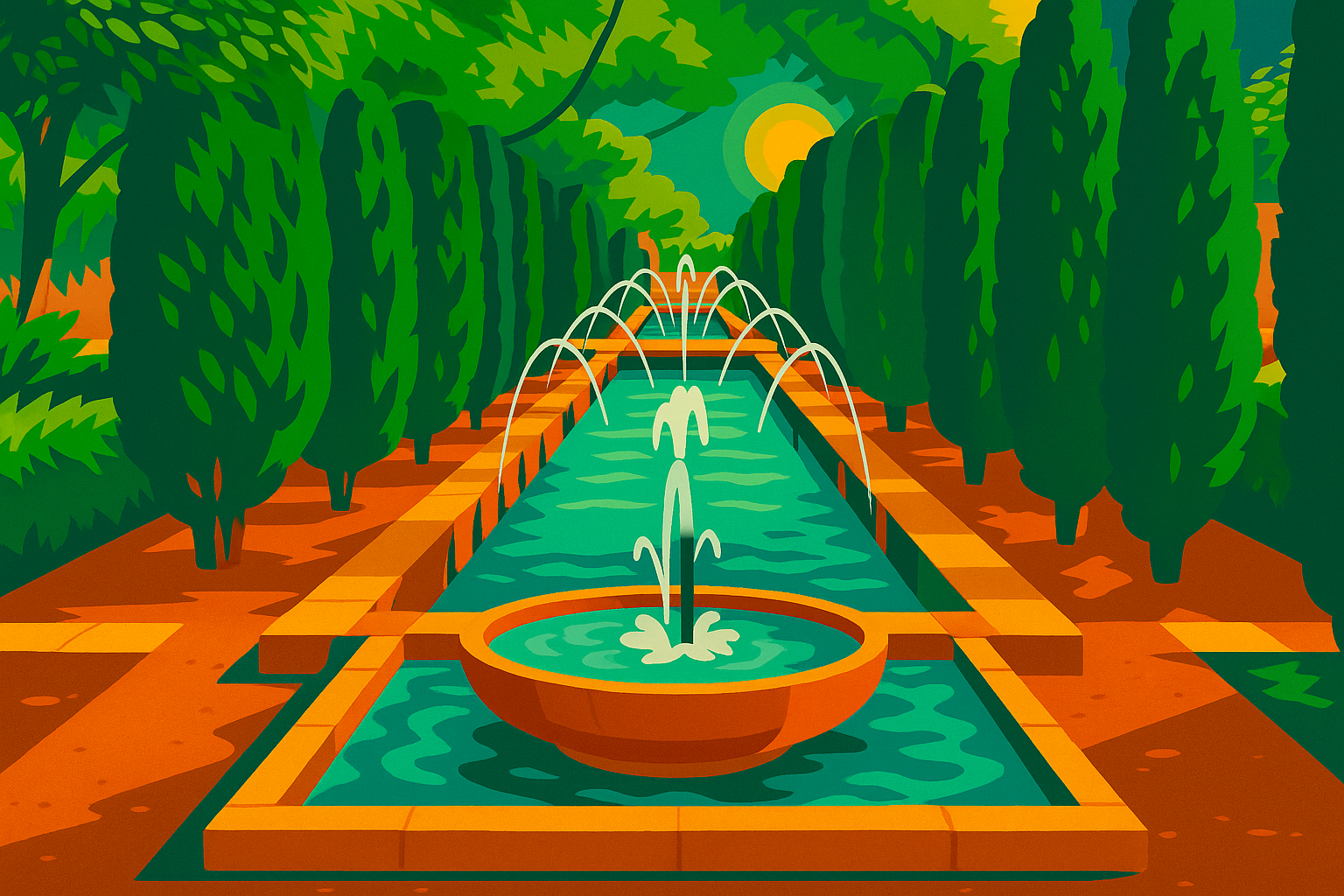
In the monumental heart of Palma de Mallorca, pressed between the imposing golden-limestone walls of the royal palace and the sun-drenched marina, lies a public garden that serves as an essential urban sanctuary: S’Hort del Rei. Its identity isn’t defined by grand scale, but by the profound and welcome contrast it offers to its surroundings. This is an intimate complex of abundant shade, soaring cypress trees, and the meditative atmosphere of trickling fountains, offering a cool, peaceful, and necessary respite from the intense Mediterranean sun.
The name, S’Hort del Rei, translates from Catalan as “The King’s Orchard,” but this is a historical echo, not a literal description. If you arrive seeking the functional royal plot of the Middle Ages, you won’t find it. The 14th-century original was a private, enclosed space dedicated to growing fruit trees, vegetables, and flowers for the palace. What stands today is a 20th-century aesthetic reinterpretation—a tranquil Moorish-style garden designed for public relaxation. It is a place where layers of history, some authentic and some romanticized, converge with significant modern art and the daily life of the city.
The garden’s true value is relative. Its deep shade is cherished precisely because the surrounding plazas are sun-exposed. Its tranquility feels profound because it is located at the nexus of Palma’s busiest tourist circuit, wedged between the Royal Palace of La Almudaina, La Seu Cathedral, and the bustling Passeig des Born. It is the unmissable green oasis that makes a visit to the city’s monumental core not just possible, but civilized.
From Royal Orchard to Public Promenade: A Layered History
The story of S’Hort del Rei is a fascinating tale of urban transformation, demolition, and the conscious manufacturing of heritage. The garden you see today is not an ancient, preserved landscape but a 20th-century creation built upon a site of layered, and often contradictory, history.
The Medieval Origins
The original Hort del Rei was established in the 14th century, during the reign of the Kings of Majorca. This was not a public park but a private, functional, and enclosed royal property. Its purpose was purely practical: it served as the palace’s orchard for fruit trees, a kitchen garden for vegetables, a source of medicinal plants, and even a place where animals like rabbits were bred for the royal table.
The Lost Centuries and a 20th-Century Vision
This medieval garden was eventually lost to time and aggressive urban development. For much of the 19th and early 20th centuries, the area was not a garden at all. Instead, this prime location at the foot of the palace was occupied by a block of city buildings, including the Alhombra Hotel, a lyric theatre, and various shops.
The garden’s modern origin story begins in the 1960s with a sweeping urban renewal plan led by the Mallorcan architect Gabriel Alomar. This revitalization was a deliberate act of demolition. Alomar’s plan called for the buildings on this site to be torn down to create new gardens. This was part of a grander vision to restore the surroundings of the Almudaina palace and highlight the architectural heritage of medieval Palma, which had been obscured by modern construction.
Alomar’s Redesign: A Manufactured Heritage
Crucially, Alomar did not—and could not—restore the original 14th-century Mallorcan orchard. His creation was an entirely new, idealized “historical-style” garden. The new layout, as one analysis notes, “has little relationship with the mediaeval one.”
Instead of replanting a functional vegetable plot, Alomar found his inspiration in traditional Andalusian gardens, which he felt were more aesthetically appropriate for the Almudaina’s own Moorish history. Specifically, he modeled the central garden on the Acequia Garden of the El Generalife Palace in Granada. This decision was an act of revisionist urbanism: Alomar fabricated a romanticized, 14th-century Moorish past for a site that was, in reality, a 14th-century Mallorcan orchard. He built a picturesque foreground for the palace, one that aligned better with a tourist-facing, pan-Spanish identity.
An Andalusian Dream in Mallorca: The Garden’s Design
The landscape architecture of S’Hort del Rei is a deliberate, academic expression of history, as envisioned by Gabriel Alomar. It is a meticulous “conciliation” of styles, curated to tell a specific story of Palma’s past.
Alomar’s 1960s design was a conscious expression of the conciliation between Spanish-Muslim gardening, Italian Renaissance gardening, and the island’s own gardening tradition. These three influences are woven together to create a unique and serene environment. The Spanish-Muslim aesthetic is dominant, a clear tribute to the magnificent heritage of al-Andalus. You can see it in the ornate fountains, small watercourses, and reflective ponds, all elements designed to cool the air and create a calm, almost meditative atmosphere reminiscent of Granada.
The Italian Renaissance influence is visible in the garden’s formal, structured layout, which features elegant terraces and geometric flower beds. Finally, the traditional Mallorcan element is most clearly represented by the long, overgrown pergola lined with benches—a classic and beloved feature of local gardens, offering a perfect spot to sit and watch the world go by.
The Crown Jewel: The Arc de la Drassana
The garden’s single most significant historical artifact is the Arc de la Drassana (Arch of the Shipyard), which gracefully overflows the swan’s pond. This is no mere garden folly; it is one of Palma’s few extant reminders of its Arab past.
Believed to be of Arab origin, it originally served as the seaward entrance into the medieval shipyards (drassana). This context is key to understanding Palma’s geography: before the construction of the modern seafront promenade, the sea reached the foot of the city walls, lapping at this very arch. Alomar’s design brilliantly re-contextualized this authentic artifact. By placing it scenically over a new, artificial pond, he transformed the 1960s garden into a curated museum for the arch, using his Andalusian-style creation as a romanticized setting to display this genuine piece of Palma’s Islamic history.
A Gallery Among the Cypresses: The Sculptures of S’Hort del Rei
Beyond its landscape design, S’Hort del Rei functions as one of Palma’s most important and accessible open-air sculpture galleries. The collection is not random; it is a curated dialogue between local identity, classical heritage, and international modernism.
Local Roots and Classical Forms
Your artistic tour begins with Llorenç Rosselló’s *El Foner* (The Balearic Slinger). This realistic, Rodin-influenced bronze sculpture, cast in 1970 from an 1898 original, depicts the mythical Balearic slingers who fought as mercenaries in the Punic Wars. It is a powerful symbol of Mallorca’s ancient, pre-Spanish identity.
Nearby, you’ll find Josep Maria Subirachs’s *Jònica* (1989), a modern marble sculpture representing a woman’s body as a classical Ionic column. The scrolls of the column’s capital cleverly form the breasts, fusing the human form with the island’s deep classical Mediterranean heritage.
The Calder-Miró Connection: A Story of Art and Friendship
The most internationally significant work in the garden is Nancy, by the celebrated American modernist Alexander Calder. Its presence in Palma is a direct result of the unusually close and lifelong friendship between Calder and Palma’s favorite son, the artist Joan Miró.
The story is a landmark event in Palma’s cultural history. Miró, who lived on Mallorca, was instrumental in organizing a major exhibition of Calder’s work at Palma’s Sala Pelaires gallery in 1972. Following the exhibition, Miró persuaded his friend Calder to donate the large-scale, iron “Stabile-Mobile” to the Ajuntament de Palma (the city council).
The donation, however, was nearly thwarted by bureaucracy. Local officials were unenthusiastic, as a sizeable amount of customs duties and excise tax was due. The artwork sat in limbo until “bigshots in Madrid” intervened, classifying *Nancy* as a *patrimonio nacional* (national heritage), thereby making it exempt from import duties. Only then did the city of Palma graciously accept the gift. There is a final irony to the story: Calder’s expressed wish was to have his mobile sculpture placed in Palma’s new Parc de la Mar, allowing the sea breeze to gently keep *Nancy* moving. Instead, the city placed it in the more sheltered S’Hort del Rei, where it has stood since 1974.
An Insider’s Guide to Visiting S’Hort del Rei
S’Hort del Rei is a gem for all visitors, from budget-conscious travelers to families and art lovers. It is small and easy to navigate, yet it warrants a dedicated stop rather than just a quick pass-by.
Admission, Hours, and Facilities
Entry to the gardens is free. They are open daily with long, generous hours that vary by season. In summer, you can visit from 7:40 am to 10:00 pm (22:00), and in winter from 7:40 am to 8:30 pm (20:30). The garden is well-equipped with ample benches for rest. For those with children, it is a kid-approved destination, featuring a well-equipped and, most importantly, shaded playground.
The Visitor Experience: Commerce and Crowds
Be prepared for the dual economy of the gardens. From Easter until the end of October, the gardens host a formal artisan market. Over twenty stalls run by local artisans from Mallorca line the walkways, selling high-quality goods made from wood, wool, leather, and ceramic. This market typically operates four days a week (Monday, Tuesday, Friday, and Saturday) from 10:00 am to 5:00 pm (17:00). At other times, you may encounter street vendors selling various goods, which can sometimes cause slight congestion along the paths.
Strategic Timing: An Insider’s Strategy
There is conflicting advice on the “best” time to visit, as the ideal moment depends entirely on your goal. For photography and a quiet atmosphere, the best time is in the early morning or evening. This allows you to avoid the tourist crowds and experience the calm, meditative atmosphere. Photographers should aim for the “golden hour” (sunrise and sunset) to capture the softest light and the beautiful interplay of light and shadow.
For comfort and a family respite, the best time to visit is around noon. While this is peak time for heat and crowds in the rest of Palma, it is precisely when the garden’s abundant shade is most valuable, making it the perfect spot for a midday break.
Key photographic spots include capturing the Arc de la Drassana reflected in the swan pond, and using the garden’s fountains and arches to create a captivating perspective that frames the magnificent walls of the Almudaina Palace and La Seu Cathedral.
Getting There and Getting Around: Transport and Accessibility
S’Hort del Rei’s central location makes it one of the most accessible points in Palma’s historic center. You’ll find it at Av. d’Antoni Maura, 18, 07001 Palma.
- By Foot: This is the primary method of arrival. The gardens are an easy walk from the Cathedral, the Almudaina Palace, and the Passeig des Born.
- By Public Transport: Palma’s EMT city bus network is highly efficient. Local buses frequently stop near the cathedral and marina areas. The A1 airport bus also has a convenient stop nearby.
- By Car: Driving and parking in central Palma are challenging. There is no dedicated parking for the garden. The nearest options are large, public underground garages just a few steps away, including Parc de la Mar (a large 748-space garage), Parking Carrer del Moll, and Parking Marina.
On-Site Accessibility
There are no public toilets located within the small gardens themselves. However, free public toilets with universal accessibility are available nearby on the Camino de La Escollera. Toilets are also available to customers of the Parc de la Mar underground car park.
The gardens are wheelchair friendly and feature paths suitable for walking and rolling. This is a critical feature for visitors with mobility needs. While the cobbled streets and narrower lanes of the deeper Old Town can be prohibitive, the contiguous stretch of the Passeig des Born, S’Hort del Rei, and the adjacent Parc de la Mar form an easy-access corridor of smooth, flat, wide paths. This allows visitors with strollers or wheelchairs to comfortably access the monumental core and enjoy spectacular views of the Cathedral and Palace.
The Monumental Heart of Palma
The ultimate significance of S’Hort del Rei is its location. It is the essential connective tissue that links the city’s most important landmarks. A visitor standing in the garden is at the nexus of Palma’s “Big 3” attractions:
- The Royal Palace of La Almudaina: The gardens are at the foot of this former Moorish fortress.
- La Seu Cathedral: The gardens rest in the shadow of the cathedral walls, with the magnificent Gothic structure looming above.
- Passeig des Born: The gardens mark the beginning of the city’s most elegant, tree-lined avenue for shopping and strolling.
This central role was, in fact, the garden’s entire purpose. Alomar’s 1960s plan was a masterful act of urban design. By demolishing the buildings that once stood on this spot, he created a clear, beautiful, and scenic foreground. The garden was explicitly designed to frame your encounter with the Palace and Cathedral, creating captivating perspectives and beautiful photographic moments. S’Hort del Rei is, in essence, the red carpet of Palma—a green and shaded path that stages your approach to the monumental grandeur of the city.