
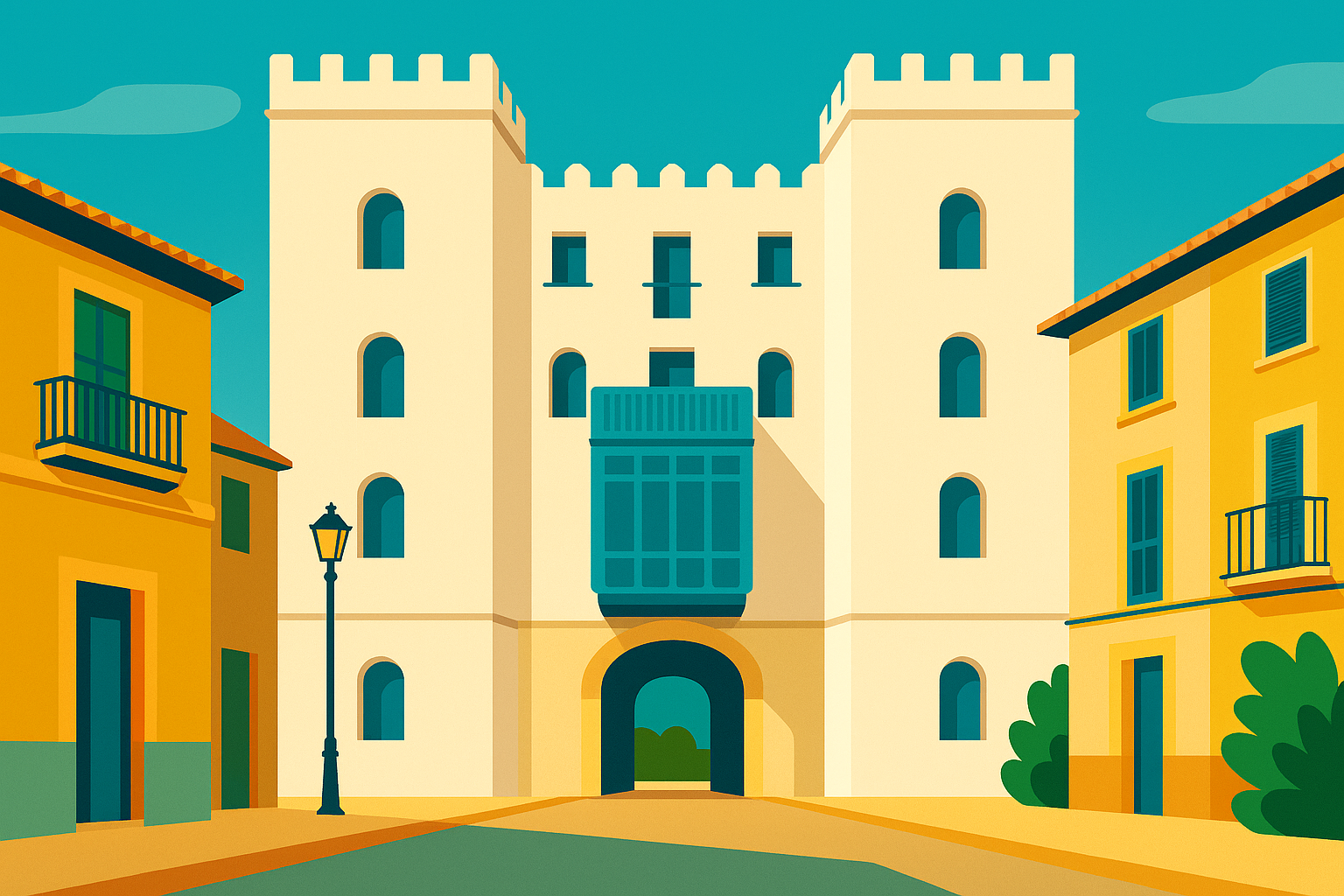
Towers of the Temple
Discover the most beautiful coves
To explore the hidden coves and move freely around the island, a car is your best solution. We recommend booking one in advance to secure the best price and not miss a single corner of paradise.
🔍 Find the perfect car for youThe Silent Sentinels: Uncovering the True Templar Legacy at Palma’s Torres del Temple
A search for the “Temple” in Palma de Mallorca will almost certainly lead you astray. Your search engine, your guidebook, even a well-meaning local might point you towards the staggering, honey-gold Gothic masterpiece that dominates the city’s skyline: the Cathedral of Santa Maria of Palma, affectionately known as ‘La Seu’. You might arrive expecting tales of the Knights Templar, but instead, you’ll find the modernist architectural reforms of Antoni Gaudí, the world’s largest Gothic rose window, and the ethereal “spectacle of the 8” light phenomenon.
This is not that place.
To find the true, tangible legacy of the Knights Templar, you must turn your back on the sun-drenched Parc de la Mar and the cathedral’s magnificent flying buttresses. This quest requires a deliberate pilgrimage, a journey away from the crowds and into the labyrinthine heart of Palma’s Old Town, the Casco Antiguo. Down a narrow, quiet street, unassuming and almost hidden from the casual glance, stand the Torres del Temple. This is no soaring church. It is an austere, formidable 12th-century fortress, a structure that speaks of power, not prayer. Its solid twin towers and formidable stone archway are the real, authentic headquarters granted to the Knights Templar by a grateful King Jaume I after the conquest of 1229. To find El Temple is to bypass the city’s greatest spectacle and, in doing so, discover one of its deepest secrets—a true palimpsest of Islamic, Templar, and Hospitaller power, hidden in plain sight.
A Journey into Palma’s Secret History
From Sun-Drenched Promenades to Shadowy Alleys
Walking from the grandeur of Palma’s seafront promenade into the Sa Calatrava district is a journey of sensory compression. The wide, bright vistas of the bay, filled with the scent of salt and the sound of waves, are replaced by a tight-knit web of medieval streets. The air stills. The sounds of traffic and tourism are muted by tall, sandstone walls that have absorbed centuries of secrets. The Carrer del Temple itself is a place of shadows and stone, a corridor that feels intentionally secretive, designed to be found only by those who are truly looking.
The atmosphere here is one of austerity, not welcome. The Torres del Temple do not invite you in; they loom over you. They were built for defence and control, and they retain that formidable character to this day. Unlike La Seu, which was designed to inspire awe and devotion in the hearts of the faithful, this structure was designed to project power and ensure security. It is a military building, a repository for the spoils of war, and the command centre of a warrior-monk order that shaped the course of European history.
The Symbolism of Power
The symbolism of the site is potent and layered. The two towers, the “silent sentinels” of this forgotten enclave, represent a direct and physical transfer of power. They are Islamic in origin, a key defensive gate to the Moorish city, yet they became the very symbol of the Christian military order that conquered it. The heavy, rounded archway is more than just an entrance; it is a portal between epochs. Standing beneath it, you are crossing a boundary that separates the Moorish Madina Mayurqa from the Christian Palma that was to rise from its ashes. It is a physical manifestation of conquest and transformation, a story told not in stained glass, but in solid, unyielding stone.
The Three Lives of El Temple: A Story Etched in Stone
The stones of El Temple tell a story in three distinct chapters, a narrative far more complex and fascinating than most visitors realise. To understand this building is to understand the very foundation of modern Palma, a history of conquest, faith, and political upheaval.
Era 1: The Moorish Fortress (pre-1229)
Before the Reconquista, Palma was known as “Madina Mayurqa,” a prosperous and sophisticated Almohad city. The structure we see today was not built by the Templars, but by their predecessors. It was the Almudaina de Gomera (or “Gumara”), a 12th-century Islamic fortification. This was more than just a castle; it was a strategic, fortified double gate controlling the eastern access to the city. It was held by the powerful Berber Gumara tribe, who dominated this part of the island. The towers and the arch, at their very core, are a rare and precious surviving piece of Islamic military architecture in Palma.
Era 2: The Knights Templar Headquarters (1229–1312)
The Christian conquest of Mallorca in 1229 was led by King Jaume I of Aragon, a monarch with a deep personal connection to the Templars. Having been orphaned as a child, he was educated and protected by the Order at Monzón Castle. In his campaign to reclaim Mallorca, the Templars were not mere soldiers but an elite fighting force, contributing their strategic prowess and military might to the invasion.
As documented in the Llibre del Repartiment (the “Book of Distribution” that meticulously divvied up the conquered lands), Jaume I rewarded his most crucial allies with the spoils of victory. The Templars were granted this strategic fortress as their primary headquarters on the island. They immediately began to transform the interior, adding a residence for their commander and a private chapel, consecrating the Muslim stronghold for Christian use and establishing their powerful presence in the newly conquered city.
Era 3: The Knights of Malta and the Great Confiscation (Post-1312)
This is the crucial, often-missed part of the story. The Templar’s golden age in Palma was brutally brief. In 1312, Pope Clement V, under immense pressure from a debt-ridden King Philip IV of France, suppressed the powerful order. Their vast wealth and properties across Europe were seized. In Mallorca, El Temple was not left to ruin or taken by the crown; it was transferred to the other great military order of the day, the Order of Saint John of Malta (the Knights Hospitaller). For nearly 500 more years, it remained a site of military-religious importance, continuing its legacy under a different banner.
The final blow came in 1835. The Spanish government, desperate to raise funds during the Carlist Wars, enacted the Desamortización de Mendizábal. This massive secularisation policy confiscated all monastic and conventual properties in Spain. The fortress was seized from the Order of St. John and sold to private investors. Stripped of its purpose, its assets, and its protectors, it fell into the “poor condition” lamented by 19th-century poets, its treasures dispersed. This 1835 confiscation is the single most important reason why, today, the Torres del Temple is a silent, private monument and not a grand, state-run museum.
Visiting the Torres del Temple: What to Expect
Opening Hours and Access: The Essential Truth
This is the most critical piece of practical information for any prospective visitor, and where most confusion arises. The Torres del Temple is not a public museum and is generally not open for interior visits. Despite occasional reports or old guidebook entries suggesting it is “scheduled to hold a museum,” this is not the current reality.
Therefore, the visit is an exterior one, conducted from the public street.
- Admission: Free.
- Opening Hours: The exterior is visible 24/7 from Carrer del Temple.
- Recommended Visit Duration: A brief but meaningful 15–30 minutes. This is not a half-day excursion. It is a deliberate, focused act of historical discovery. The value is not in “touring” but in “finding”—locating the site, absorbing its powerful atmosphere, and understanding its place in the complex tapestry of the city.
Architecture: A Tale of Two Cultures
The architectural importance of the Torres del Temple lies in its unique, syncretic nature. It is a rare blend of stern Moorish military design and subtle, early Christian additions—a stark contrast to the flamboyant Levantine Gothic that defines La Seu.
The primary feature, visible to all, is the Moorish Gate. The two solid, imposing towers and the massive, unadorned rounded arch that connects them are the most complete remnants of the 12th-century Islamic Almudaina de Gomera. This is architecture of defence, not decoration, built with function and intimidation in mind.
The Templar additions are hidden within the courtyard, generally inaccessible to the public. Here, the warrior-monks built their chapel. This structure is of immense value to architectural historians as it represents a rare example of the late Romanesque style in Palma, an architectural period largely skipped over by the rapid arrival of the Gothic. For the truly dedicated history enthusiast, there is a tangible link to this hidden past. A precious Gothic panel, the Panel of Saint Bernar (depicting the Lactation of Saint Bernard), was originally created for this Templar chapel. Today, this priceless piece of art is no longer on-site but is preserved and displayed at the nearby Diocesan Museum, just a short walk away.
Practical Guide for Your Pilgrimage
How to Find the Silent Sentinels
Finding the Torres del Temple is an essential part of the experience. It is located at Carrer del Temple, 9, 07001 Palma, deep within the oldest part of the city. It sits in the historic Sa Calatrava district, adjacent to the Call Jueu, the old Jewish Quarter. The Casco Antiguo is a maze of narrow, medieval streets and is largely pedestrianised, making arrival on foot by far the best method.
- From La Seu (Cathedral): A scenic 10 to 12-minute walk. Head inland (north-east) away from the sea, navigating past the Banys Àrabs (Arab Baths) into the Sa Calatrava neighbourhood.
- From Plaça de Cort (Town Hall): A shorter 5 to 7-minute walk. Head east into the warren of streets, using the Convent of Santa Clara or the Basílica de Sant Francesc as nearby landmarks.
For those using public transport, the strategy is to reach the perimeter of the Old Town and walk from there. The city’s EMT Palma bus network is efficient. EMT Bus lines 23, 25, 31, or A2 all have stops convenient to the Old Town. The closest and most logical stops are Porta Des Camp or Plaça de la Reina (for Bus 25), both of which leave you with a pleasant 10 to 15-minute walk to the site.
Facilities and Accessibility
Reflecting its status as a historic monument rather than a tourist attraction, the Torres del Temple has no public facilities or services on-site. You will not find restrooms, audio guides, a ticket office, or a café.
Furthermore, accessibility is extremely limited. The Carrer del Temple is a narrow, medieval street, and like much of the Casco Antiguo, it is uneven and cobbled. While the façade can be viewed from the street by those with mobility aids, the terrain is challenging. The complete lack of accessibility information for this site confirms it is not an adapted tourist site. However, the surrounding Old Town neighbourhoods are replete with services, and a short walk in any direction will lead you to charming independent cafés and local bars.
The Best Time for a Contemplative Visit
The best time to visit the Torres del Temple is dictated by atmosphere and photography. Unlike the Cathedral, where one might time a visit for a specific light phenomenon, the magic of El Temple is in its daily, quiet solitude.
Visit in the early morning (8:00–10:00). At this hour, the Old Town is still waking up, and foot traffic is minimal. The soft, “golden hour” light illuminates the sandstone of the towers, creating a reverent and deeply historic atmosphere. This is the ideal time for contemplation and photography. Alternatively, the late afternoon (17:00–19:00) offers a similar effect, casting long, dramatic shadows down the narrow street. Avoid the middle of the day in peak summer, when the light is harsh and the heat trapped between the stone walls can be stifling.
Beyond the Towers: A “Hidden Palma” Itinerary
The 15-minute stop at Torres del Temple is best understood as an anchor point for a wider “Multi-Layered History” walking tour. Its location is perfect for exploring other authentic, non-commercial sites.
- Banys Àrabs (Arab Baths): Located just a 5-minute walk away, these baths are the other most significant public remnant of Palma’s Moorish past. Visiting El Temple and the Arab Baths together creates a powerful “Moorish & Reconquista” themed walk.
- Convent of Santa Clara: A 1-minute walk from El Temple, this 13th-century Gothic convent is a place of serene, living history, offering a fascinating glimpse into the city’s deep religious heritage.
- The “Call Jueu” (Jewish Quarter): The Torres del Temple stands on the very edge of the old Jewish Quarter. From the fortress, you can immediately plunge into the evocative, winding streets of Carrer de Montesión and Carrer del Vent, which once formed the heart of Palma’s Sephardic community.
- Basílica de Sant Francesc: A 5-minute walk away, this monumental Gothic church and its stunning cloister offer a beautiful contrast to the austere military architecture of El Temple.
A fantastic insider tip for this walk: at the Convent of Santa Clara, seek out the small revolving hatch (torno). Here, the cloistered nuns sell delicious homemade almond biscuits and sweets, a tradition that has supported the convent for centuries. It’s the perfect treat to enjoy while you continue your historical exploration.
Capturing the Fortress: Photography Tips
Capturing the essence of the Torres del Temple is a challenge due to the narrowness of the street, but this constraint forces a more creative approach.
- The Classic Façade: Stand directly opposite the entrance on Carrer del Temple. A wide-angle lens is essential to capture the full archway and both towers in a single frame.
- The Contextual Frame: Walk to either end of the street and use the narrow, shadowy alley as a natural “frame” for the towers. This shot emphasizes the “hidden” nature of the site, embedding it within the dense urban fabric of the Old Town.
- The Detail Shot: Step close to the archway. Focus on the texture of the massive, wedge-shaped stones (voussoirs) of the Moorish arch. Capture the contrast between the ancient, weathered stone and the modern blue-and-white street plaque for “Carrer del Temple”.
A Final Thought: The Reward of Seeking the Unseen
Palma’s history is not always presented on a grand scale. While the Cathedral demands your attention with its sheer size and beauty, the city’s deeper, more complex soul resides in places like the Torres del Temple. It is a relic that does not offer a show, a ticket, or a tour. It simply endures, a silent witness to the rise and fall of empires.
Do not look for a ticket booth or a grand entrance. The ‘visit’ is the act of finding it. Stand in the archway and realise you are in the same spot as a 12th-century Moorish guard, a 13th-century Knight Templar, and a 16th-century Knight of Malta. That is the true experience.